Individual Performance Contract : Balancing Strategy, Operational and AdHoc KPIs for Fair Appraisal
The S–O–W weighting framework aligns KPIs to an employee's level of influence by separating Strategic, Operational, and Work-Beyond-Plan contributions. It improves fairness, transparency, accountability, and scorecard alignment while ensuring performance evaluations reflect both role execution and organisational impact.

A common mistake in performance management is treating all KPIs as equally important. In reality, not all contributions carry the same strategic value. A well-designed Performance Management System therefore "wraps" KPIs within an agreed Strategic (S), Operational (O), and Work-Beyond-Plan (W) weighting structure to reflect the employee's level of influence, responsibilities, and contribution to organisational success. This approach improves fairness, transparency, and scorecard alignment while ensuring that employees are evaluated on both outcomes and execution.
The S–O–W framework separates performance into three distinct dimensions. Strategic (S) measures contribution to company or departmental scorecards and long-term objectives. Operational (O) measures execution of the role, service standards, quality, compliance, and recurring deliverables. Work-Beyond-Plan (W) captures significant ad-hoc assignments, special projects, crisis management, or additional responsibilities outside the original performance contract. By separating these dimensions, organisations can distinguish between moving strategy, performing the job well, and contributing exceptional value beyond expectations.
Step 1: Determine S–O–W Weight by Organisational Level
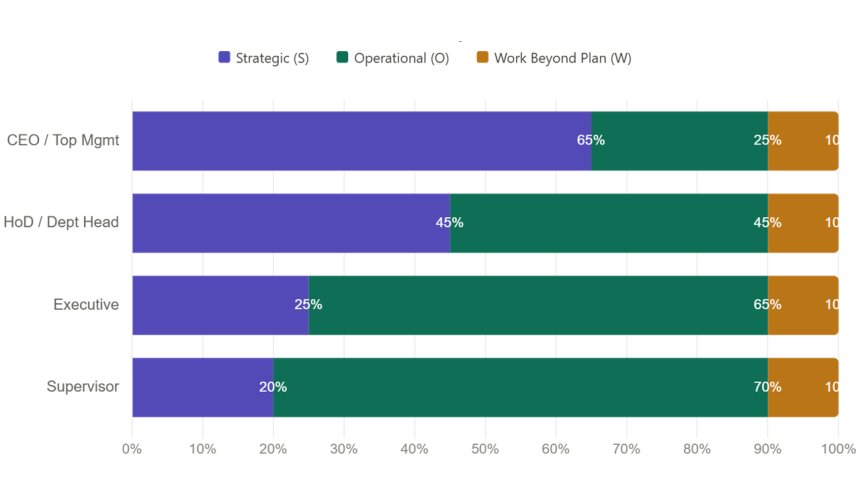
The weighting should reflect the employee's degree of influence over strategic outcomes. Senior leaders should carry higher strategic weight because they have greater control over organisational direction, while executives and frontline staff contribute primarily through operational execution.
| Role Level | Strategic (S) | Operational (O) | Work Beyond Plan (W) |
|---|---|---|---|
| CEO / Top Management | 65% | 25% | 10% |
| HoD / Department Head | 45% | 45% | 10% |
| Executive | 25% | 65% | 10% |
| Supervisor | 20% | 70% | 10% |
Step 2: Assign KPI Weight Within Each Section
Once the overall S–O–W weighting is determined, distribute the weight among the critical KPIs within each section.
Example: Head of Business Development & Planning
Section S – Strategic (45%)
| Objective | KPI | Weight |
|---|---|---|
| Revenue Growth | New Business Revenue (RM) | 20% |
| Pipeline Development | Qualified Pipeline Value (RM) | 15% |
| Market Expansion | New Customers Acquired | 10% |
| Total Strategic | 45% |
Section O – Operational (45%)
| Objective | KPI | Weight |
|---|---|---|
| Proposal Management | Tender Win Rate (%) | 15% |
| Customer Engagement | Key Account Reviews | 10% |
| Planning | Strategic Initiatives Delivered (%) | 10% |
| Governance | Reporting & CRM Compliance (%) | 10% |
| Total Operational | 45% |
Section W – Work Beyond Plan (10%)
| Objective | KPI | Weight |
|---|---|---|
| Special Projects | Strategic Project Leadership | 5% |
| Ad-Hoc Assignments | Board / Management Assignments | 5% |
| Total WBP | 10% |
Step 3: Calculate Final Performance Score
Each KPI is rated, subtotaled within its section, and then multiplied by the agreed section weight. The final score combines Strategic, Operational, and Work-Beyond-Plan contributions.
Total Annual Score

= (Strategic Score × Strategic Weight)
+ (Operational Score × Operational Weight)
+ (Work-Beyond-Plan Score × Work-Beyond-Plan Weight)
Example:
| Section | Score | Weight | Weighted Score |
|---|---|---|---|
| Strategic | 4.2 | 45% | 1.89 |
| Operational | 4.0 | 45% | 1.80 |
| Work Beyond Plan | 4.5 | 10% | 0.45 |
| Total Score | 4.14 |
Guiding Principle
KPIs define what is measured; S–O–W weighting defines what matters most. A revenue KPI and an administrative KPI may both be important, but they should not necessarily carry the same weight. Wrapping KPIs within an appropriate S–O–W structure ensures that performance ratings reflect the true value of an individual's contribution, aligned to their role, authority, and impact on organisational success.
IPC Template SOW
Share
 Like
0
Like
0
 Dislike
0
Dislike
0
 Love
0
Love
0
 Funny
0
Funny
0
 Angry
0
Angry
0
 Sad
0
Sad
0
 Wow
0
Wow
0