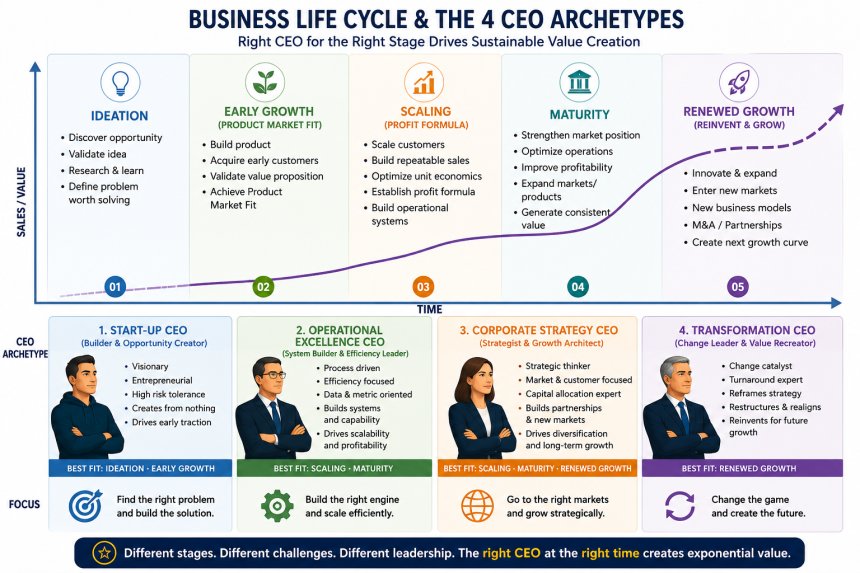
The 4 Types of CEO in a Business Lifecycle
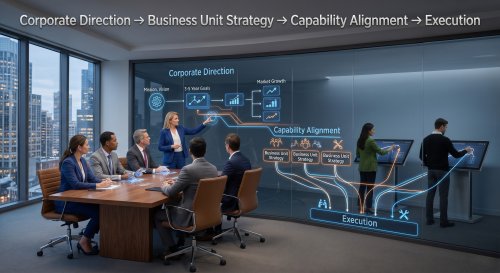
Many boards and business owners make the mistake of searching for the "best CEO" without first understanding what stage their company is in. The reality is that different stages of business growth require different leadership archetypes. A Start-Up CEO excels at creating new opportunities and building businesses from scratch. An Operational Excellence CEO focuses on systems, productivity, and sustainable profitability. A Corporate Strategy CEO drives market expansion, strategic positioning, and long-term growth, while a Transformation CEO leads organisations through disruption, turnaround, and reinvention.

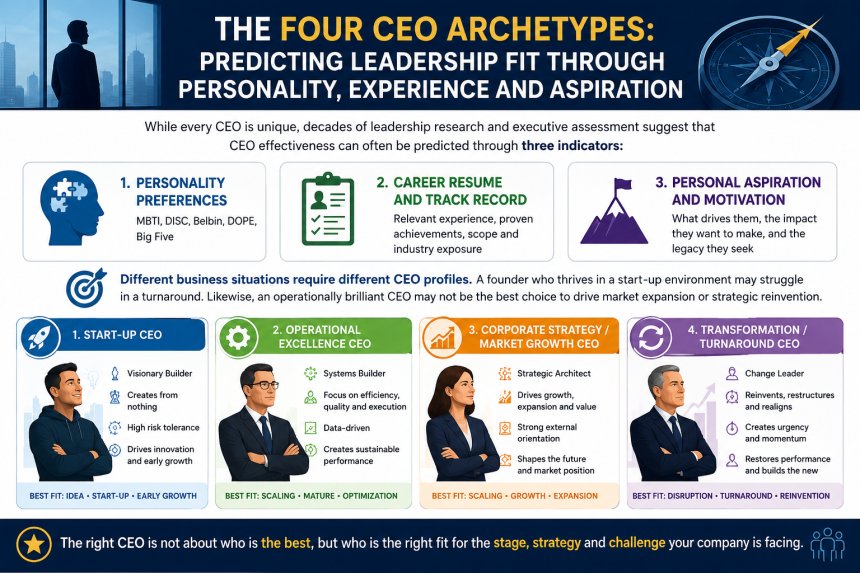
The Four CEO Archetypes: Predicting Leadership Fit Through Personality, Experience and Aspiration
While every CEO is unique, decades of leadership research and executive assessment suggest that CEO effectiveness can often be predicted through three indicators:
- Personality Preferences (MBTI, DISC, Belbin, DOPE, Big Five)
- Career Resume and Track Record
- Personal Aspiration and Motivation
Different business situations require different CEO profiles. A founder who thrives in a start-up environment may struggle in a turnaround. Likewise, an operationally brilliant CEO may not be the best choice to drive market expansion or strategic reinvention.
1. Start-Up CEO (SU)
The Start-Up CEO is a creator, builder, and opportunity seeker. They thrive in environments where resources are limited, uncertainty is high, and success depends on the ability to identify unmet market needs and transform ideas into viable businesses. Their focus is not on perfect systems or governance but on gaining traction, winning customers, securing funding, and creating momentum. They are often comfortable making decisions with incomplete information and are willing to take calculated risks that others may avoid.
Personality assessments frequently reveal strong entrepreneurial tendencies, including high dominance, influence, creativity, and adaptability. Their resumes often feature business development, product launches, commercialisation projects, or founder experiences. These leaders are best suited for the Idea, Start-Up, and Early Growth stages of a company's lifecycle, where agility, innovation, and resilience are more valuable than operational efficiency. Their greatest contribution is creating value where none previously existed.
Primary Mission
Create something from nothing.
The Start-Up CEO is responsible for identifying opportunities, building products, acquiring customers, attracting investors, and creating market presence before competitors do.
Typical Personality Profile
MBTI
- ENTP
- ENTJ
- ENFP
DISC
- High D
- High I
Belbin Roles
- Plant
- Resource Investigator
- Shaper
DOPE
- Eagle dominant
Typical Traits
- High risk tolerance
- Entrepreneurial
- Resilient under uncertainty
- Strong networking capability
- Persuasive communicator
- Visionary thinker
- Comfortable with ambiguity
Resume Indicators
- New business creation
- Business development
- Sales leadership
- Commercialisation projects
- Venture building
- Product launches
Aspiration Indicators
- Wants to build something meaningful
- Enjoys creating rather than maintaining
- Motivated by growth and opportunity
- Seeks independence and influence
Best Company Lifecycle Fit
| Lifecycle Stage | Suitability |
|---|---|
| Idea Stage | Excellent |
| Start-Up | Excellent |
| Early Growth | Excellent |
| Scaling | Moderate |
| Mature | Low |
| Turnaround | Low |
Typical Business Question
"How do we create a market that does not yet exist?"
_______
2. Operational Excellence CEO (OEx)
The Operational Excellence CEO is a system builder who transforms growth into sustainable performance. Once a business has established market demand, the challenge shifts from creating customers to consistently serving them with quality, efficiency, and profitability. These leaders focus on process discipline, productivity improvement, governance, resource optimization, quality management, and execution excellence. They bring structure to growing organizations and ensure that success can be repeated reliably.
Their personality profiles often reflect high conscientiousness, discipline, and attention to detail. They are typically associated with MBTI profiles such as ESTJ or ISTJ, high C and D tendencies in DISC, and Implementer or Completer-Finisher roles in Belbin. Their resumes frequently include operations leadership, manufacturing, supply chain, service delivery, Lean Six Sigma, or continuous improvement initiatives. They are most effective during the Scaling and Mature Enterprise stages, where the organisation must convert growth into sustainable profitability and operational resilience.
Primary Mission
Create reliability, efficiency and profitability.
The Operational Excellence CEO focuses on execution, productivity, quality, process discipline, customer delivery and sustainable performance.
Typical Personality Profile
MBTI
- ESTJ
- ISTJ
- ENTJ
DISC
- High C
- High D
Belbin Roles
- Implementer
- Completer Finisher
- Coordinator
DOPE
- Dove-Eagle combination
Typical Traits
- Process-oriented
- Data-driven
- Disciplined
- Structured decision making
- Strong governance
- Continuous improvement mindset
- Operational rigor
Resume Indicators
- Manufacturing leadership
- Supply chain management
- Operations director
- Lean Six Sigma
- Quality management
- Productivity improvement
Aspiration Indicators
- Enjoys solving operational problems
- Passionate about efficiency
- Wants to build sustainable systems
- Motivated by measurable results
Best Company Lifecycle Fit
| Lifecycle Stage | Suitability |
|---|---|
| Idea Stage | Low |
| Start-Up | Moderate |
| Early Growth | Moderate |
| Scaling | Excellent |
| Mature | Excellent |
| Declining Performance | Moderate |
Typical Business Question
"How do we produce better, faster and cheaper?"
______________
3. Corporate Strategy & Market Growth CEO (CS)
The Corporate Strategy CEO is an architect of future growth. Their role is to determine where the organisation should compete, how resources should be allocated, and which opportunities will create the greatest long-term value. They spend significant time understanding markets, customers, competitors, investors, regulators, and strategic partners. Rather than focusing primarily on internal operations, they focus on shaping the organisation's external position and ensuring relevance in an increasingly competitive environment.
These leaders often possess strong strategic thinking, influence, networking capability, and enterprise perspective. Their career histories commonly include corporate planning, mergers and acquisitions, regional leadership, business development, investor relations, and portfolio management. They are particularly effective during the Scaling, Mature Enterprise, Diversification, and Regional Expansion stages. Their greatest strength lies in creating the next growth curve before the current one reaches its limits, ensuring the organisation remains competitive and valuable over the long term.
Primary Mission
Position the company for sustainable growth.
The Corporate Strategy CEO focuses on market expansion, portfolio management, mergers and acquisitions, stakeholder management, capital allocation and long-term competitiveness.
Typical Personality Profile
MBTI
- ENTJ
- ENFJ
- INTJ
DISC
- High D
- High I
Belbin Roles
- Coordinator
- Resource Investigator
- Shaper
DOPE
- Eagle dominant
Typical Traits
- Strategic thinker
- Politically astute
- Strong external orientation
- Investor relations capability
- Influential communicator
- Strong personal branding
- Enterprise perspective
Resume Indicators
- Corporate planning
- Business strategy
- M&A
- Corporate finance
- Regional leadership
- Investor relations
- Market expansion
Aspiration Indicators
- Wants to shape industries
- Interested in large-scale impact
- Enjoys influencing stakeholders
- Motivated by growth and legacy
Best Company Lifecycle Fit
| Lifecycle Stage | Suitability |
|---|---|
| Start-Up | Moderate |
| Early Growth | Moderate |
| Scaling | Excellent |
| Mature | Excellent |
| Diversification | Excellent |
| Regional Expansion | Excellent |
Typical Business Question
"Where should we play and how do we win?"
______________
4. Transformation / Turnaround CEO (OT)
The Transformation CEO is brought in when the status quo is no longer sufficient. This leader is often tasked with revitalising organisations facing declining performance, disruptive competitors, technological shifts, cultural stagnation, or structural inefficiencies. Unlike the Operational Excellence CEO who optimises existing systems, the Transformation CEO challenges assumptions, restructures business models, realigns talent, and drives large-scale change. They create urgency, mobilise stakeholders, and lead organisations through difficult transitions.
Personality assessments frequently indicate high decisiveness, courage, resilience, and strategic foresight. Their resumes often include turnaround assignments, restructuring programs, mergers integration, business transformation, crisis management, and enterprise-wide change initiatives. They are most effective during periods of disruption, stagnation, decline, or reinvention. Their greatest contribution is not merely restoring performance but repositioning the organisation for a new future, enabling renewed growth and long-term sustainability.
Primary Mission
Save, reinvent or transform the organisation.
The Transformation CEO enters when performance has stalled, markets have shifted, disruption has occurred, or the company requires fundamental reinvention.
Typical Personality Profile
MBTI
- ENTJ
- INTJ
- ESTJ
DISC
- Very High D
- Moderate C
Belbin Roles
- Shaper
- Monitor Evaluator
- Coordinator
DOPE
- Eagle-Owl combination
Typical Traits
- Courageous decision maker
- Change agent
- High resilience
- Strong influencing capability
- Comfortable with conflict
- Future-oriented
- Creates urgency
Resume Indicators
- Turnaround assignments
- Transformation office leadership
- Restructuring projects
- Change management
- Mergers integration
- Crisis management
Aspiration Indicators
- Enjoys difficult challenges
- Motivated by legacy creation
- Wants to leave organisations better than they found them
- Enjoys solving complex systemic problems
Best Company Lifecycle Fit
| Lifecycle Stage | Suitability |
|---|---|
| Start-Up | Low |
| Growth Plateau | Excellent |
| Mature | Excellent |
| Disruption | Excellent |
| Decline | Excellent |
| Turnaround | Excellent |
| Reinvention | Excellent |
Typical Business Question
"What must change today to ensure survival tomorrow?"
_________________________
A Simple Analogy
Think of a company as a ship on a long voyage.
- The Start-Up CEO builds the ship and persuades people to join the journey.
- The Operational Excellence CEO ensures the ship runs efficiently and safely every day.
- The Corporate Strategy CEO determines where the ship should sail next and which opportunities to pursue.
- The Transformation CEO takes command when the ship is damaged, off course, or facing a storm, and successfully navigates it toward a new destination.
No single CEO type is universally superior. The best CEO is the one whose personality, experience, and aspirations align with the company's current stage of development and strategic challenges.
Contact us for your individual and independent Career Navigator Assessment and Report.
Share
 Like
0
Like
0
 Dislike
0
Dislike
0
 Love
0
Love
0
 Funny
0
Funny
0
 Angry
0
Angry
0
 Sad
0
Sad
0
 Wow
0
Wow
0