Digital Transformation Starts with a Name: The Hidden Complexity Behind Building a Retail App for 1,000+ Stores
Discover how a simple challenge—standardizing store names across 1,000 retail outlets—revealed the hidden complexity behind digital transformation and why aligning data, systems, and people is essential.

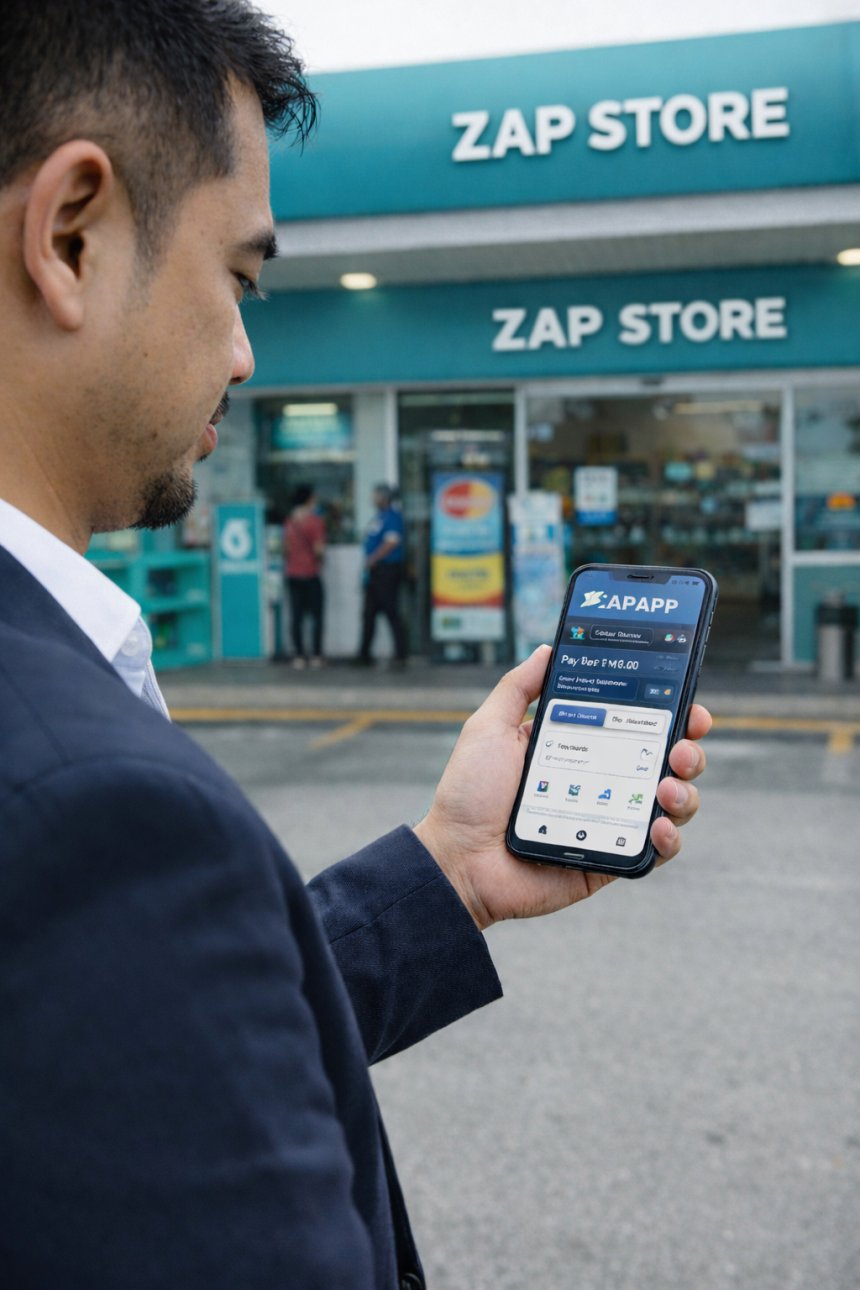

In 2016, I was involved in transforming a prominent public-listed retail organization with an ambitious agenda: embracing digital to enhance customer experience across more than 1,000 retail outlets nationwide.
The plan was exciting.
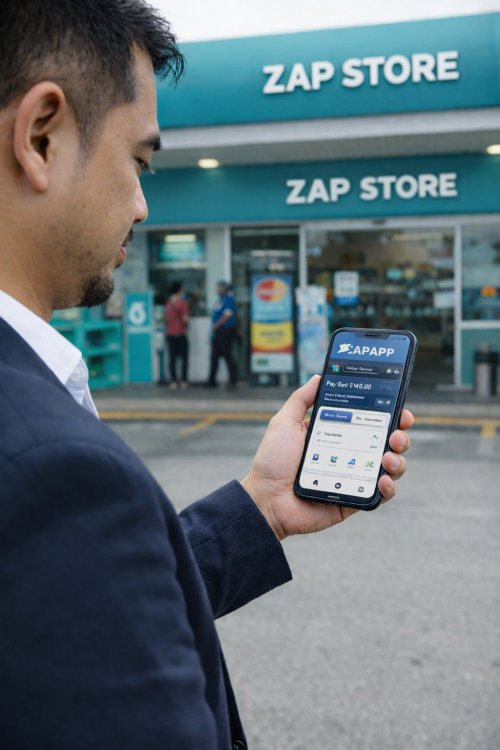
Build a mobile app that would allow customers to instantly connect with the nearest store, access product information, and complete transactions seamlessly.
Simple, right?
Not quite.
While building the app itself posed technical challenges, the biggest obstacle did not lie within the development team .
The real challenge was something far more fundamental: the organization itself.
Digital transformation rarely fails because of technology.
It fails because organizations underestimate the complexity of aligning data, systems, and people across the enterprise.
In large organizations, the biggest breakthroughs often come not from new software but from establishing a single source of truth that allows the entire organization to operate with clarity.
What Is Digital Transformation in Retail?
Digital transformation in retail involves integrating digital technologies into business operations to improve customer experience, operational efficiency, and decision-making. Successful transformation requires aligning technology with organizational data, processes, and leadership capabilities.
When Digital Meets Organizational Reality
Over the years, the company had grown into a complex enterprise. Different functions had evolved independently, each developing systems to meet their own operational needs.
Retail operations had one database.
Finance maintained another.
Network management had its own system.
Logistics managed yet another dataset.
Each system worked well within its own boundary.
But collectively, they had formed organizational silos.
This is a common reality in large organizations undergoing transformation.
Technology changes quickly.
Organizations, however, often carry years of accumulated systems, processes, and behaviors .
The App Idea That Seemed So Simple
The goal for the app was straightforward:
When a customer arrived at a retail store, the app should automatically recognize the location and display the relevant goods and services available at that outlet.
Conceptually, this required three things:
• identifying the store
• retrieving the store’s data
• enabling transactions
On paper, it sounded simple.
But the first problem appeared almost immediately.
The Problem Was the Store Name
Something as basic as the name of a retail store turned out to be surprisingly complicated.
Across the organization’s internal databases, the same outlet could appear under several different names.
Retail operations had their own naming conventions.
Finance used a different format.
Network management followed another system.
Logistics had yet another variation.
A single store might appear as:
• KL North Station
• Kuala Lumpur North Retail
• KLN Service Hub
• Station 245
All referring to the same location.
When Reality Becomes Even More Complicated
To make matters worse, the names used internally did not always match reality .
When we checked physical locations:
• the store signboards used different names
• mapping services like Google Maps displayed another variation
• navigation apps like Waze sometimes showed yet another
There were even moments when colleagues from different departments agreed to meet at the same store — only to discover they had arrived at three completely different locations , each referring to the same outlet using a slightly different name.
What initially looked like a small technical problem suddenly revealed a much deeper organizational issue.
There was no single source of truth for something as fundamental as the identity of the company’s own retail stores.
The Real Lesson of Digital Transformation
At that moment, it became clear that building a digital product is never just about writing code .
It is about untangling years of organizational complexity.
The first breakthrough in the project did not come from launching an advanced feature in the mobile app.
It came from creating something far more mundane — but far more powerful:
A Master Retail Store Registry.
Building the Organization’s Single Source of Truth
We began gathering data from every possible source:
• territory management records
• dealer contracts
• finance systems
• logistics databases
• marketing materials
• satellite coordinates from mapping services
Then came the painstaking work of cleaning and reconciling the data.
Each outlet was assigned:
• a unique identifier
• a standardized name
• a verified address
• accurate geolocation coordinates
What we initially thought would take weeks eventually took several months .
But something interesting began to happen along the way.
When Teams Start Talking
As teams collaborated to resolve the inconsistencies, they began to realize something important.
Many of the operational inefficiencies they had been facing were not isolated problems .
They were symptoms of the same root cause:
fragmented data and disconnected systems.
For the first time, departments that had previously operated in silos were now working together to create shared standards.
The Registry Became a Strategic Asset
By the time the first version of the master registry was completed, the organization had achieved far more than enabling a mobile app.
It had created a foundational asset for the entire enterprise.
Suddenly:
• finance reports aligned with operational data
• logistics routing became clearer
• mapping accuracy improved
• reporting consistency increased
• and the app could finally identify where the customer actually was
The invisible groundwork had unlocked visible transformation.
The Deeper Truth About Digital Transformation
In hindsight, the lesson was both simple and profound.
Digital transformation rarely begins with technology.
It begins with clarity.
Sometimes the most important innovation is not the feature that customers see in an app.
It is the invisible work done behind the scenes to help the organization speak the same language.
In this case, the journey toward digital transformation began not with payments, loyalty programs, or convenience features.
It began with answering a deceptively simple question:
“What exactly is the name of this store?”
What This Means for Organizations Today
Many organizations invest heavily in digital platforms, AI, and automation.
Yet transformation initiatives often struggle because the organizational foundations are not aligned.
Digital initiatives require more than technology.
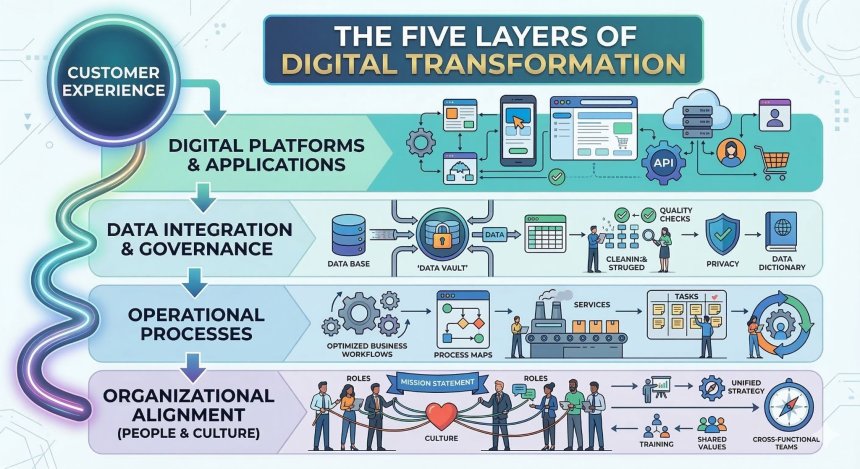
They require alignment across:
• people
• data
• processes
• systems
• leadership
As highlighted in transformation frameworks used by consulting organizations, aligning these elements is critical for sustained performance.
How Jasmiza Solutions Supports Digital and Organizational Transformation
At Jasmiza Solutions Sdn Bhd (JSSB), we often see similar challenges when organizations attempt to modernize operations or implement digital solutions.
The technology may be new, but the underlying issues frequently relate to:
• fragmented systems
• disconnected data
• misaligned processes
• capability gaps within teams
Our consulting and transformation programs help organizations address these challenges through structured frameworks that align strategy, culture, capability, and systems.
These include:
Organizational Diagnostics
Identifying operational and capability gaps that hinder transformation.
Culture and Capability Alignment
Ensuring that leadership behaviours, workforce capability, and organizational culture support transformation goals.
Structured Transformation Frameworks
Using models such as culture diagnostics and organizational alignment frameworks to guide sustainable change.
Frequently Asked Questions About Digital Transformation
Why do digital transformation initiatives fail?
Many digital transformation initiatives fail because organizations focus on technology without addressing underlying issues such as fragmented data systems, siloed operations, and leadership alignment.
What is a single source of truth in digital transformation?
A single source of truth is a centralized and standardized dataset that ensures all departments use consistent information across systems and applications.
Why is data standardization important for retail apps?
Retail applications rely on accurate location, product, and operational data. Without standardized datasets, applications cannot reliably deliver location-based services or transactions.
Lessons for Organizations Undertaking Digital Transformation
The retail app story illustrates a broader reality faced by many large organizations: digital initiatives often reveal deeper structural challenges within the organization.
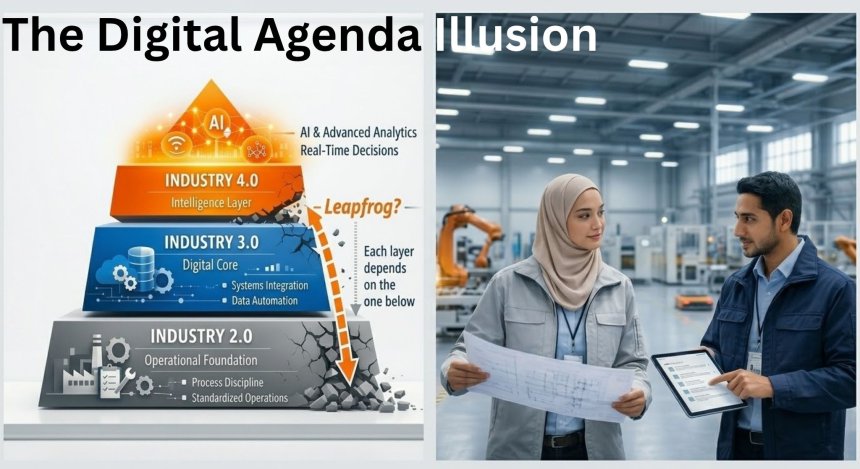
At Jasmiza Solutions Sdn Bhd, we frequently encounter similar situations when organizations attempt to implement digital platforms, improve operational efficiency, or scale their services. As explored in our article on Industry 4.0 readiness, digital transformation depends on capability maturity before intelligence platforms can succeed.
Successful transformation requires addressing the organizational foundations beneath the technology , including:
- data alignment and governance
- cross-functional collaboration
- leadership capability development
- operational process optimization
Through consulting and capability-building programs, Jasmiza Solutions helps organizations align people, systems, and strategy so that digital initiatives deliver sustainable value.
Final Reflection
In large organizations, digital transformation rarely begins with technology.
It begins with aligning people, data, and purpose.
Only when those foundations are clear can technology truly deliver its promise.
And sometimes, the journey toward transformation starts with something as simple — and as powerful — as answering a basic question:
“What exactly is the name of this store?”
Share
 Like
1
Like
1
 Dislike
0
Dislike
0
 Love
0
Love
0
 Funny
0
Funny
0
 Angry
0
Angry
0
 Sad
0
Sad
0
 Wow
3
Wow
3