Pareto Analysis
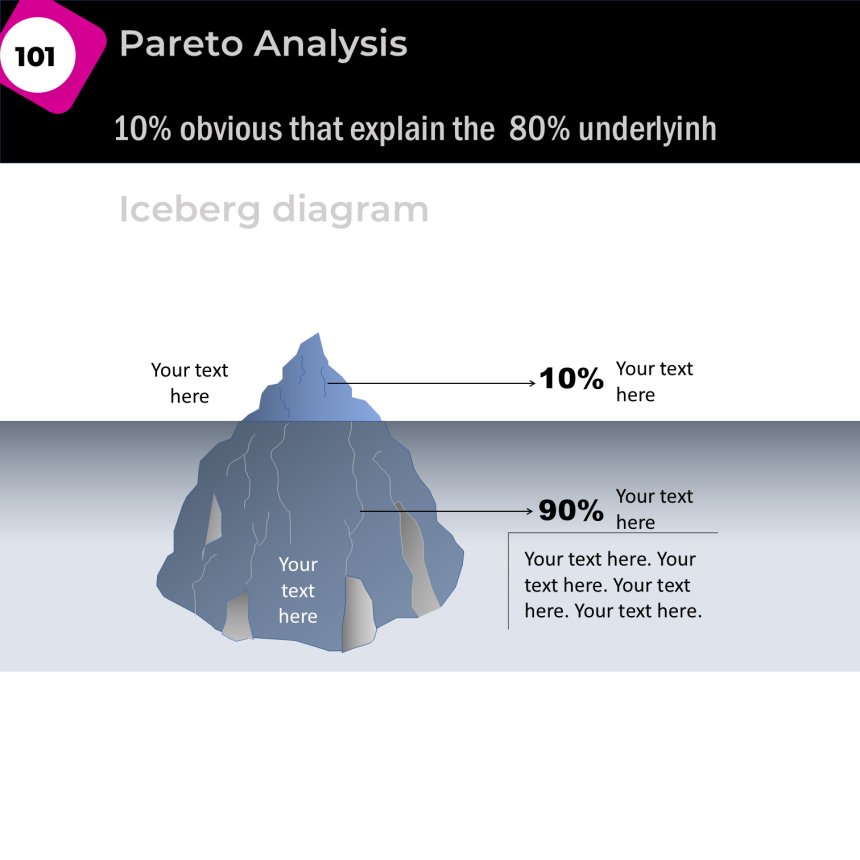
Pareto Analysis is a prioritisation tool that helps organisations identify the small number of causes responsible for the majority of problems. Based on the Pareto Principle, often referred to as the 80/20 Rule, the method suggests that approximately 80% of effects are generated by 20% of causes. By categorising and quantifying issues according to frequency, cost, impact, or occurrence, Pareto Analysis enables teams to focus their improvement efforts on the "vital few" causes that will produce the greatest benefit. It is widely used in quality management, operational excellence, customer service, manufacturing, safety, and continuous improvement initiatives.

How to Use
Pareto Analysis begins by collecting and categorising data related to the problem being investigated. This may include customer complaints, defects, machine breakdowns, incidents, delays, or other performance issues. Each category is then quantified based on frequency, cost, duration, or another relevant measure. The categories are arranged in descending order from highest to lowest impact.
Next, a Pareto Chart is constructed, showing individual categories as bars and cumulative percentages as a line graph. By examining the chart, the team can identify the small number of categories that contribute most significantly to the overall problem. Improvement efforts are then focused on these high-impact areas to achieve the greatest return on investment. Once corrective actions have been implemented, the analysis can be repeated to assess progress and identify the next priority areas.
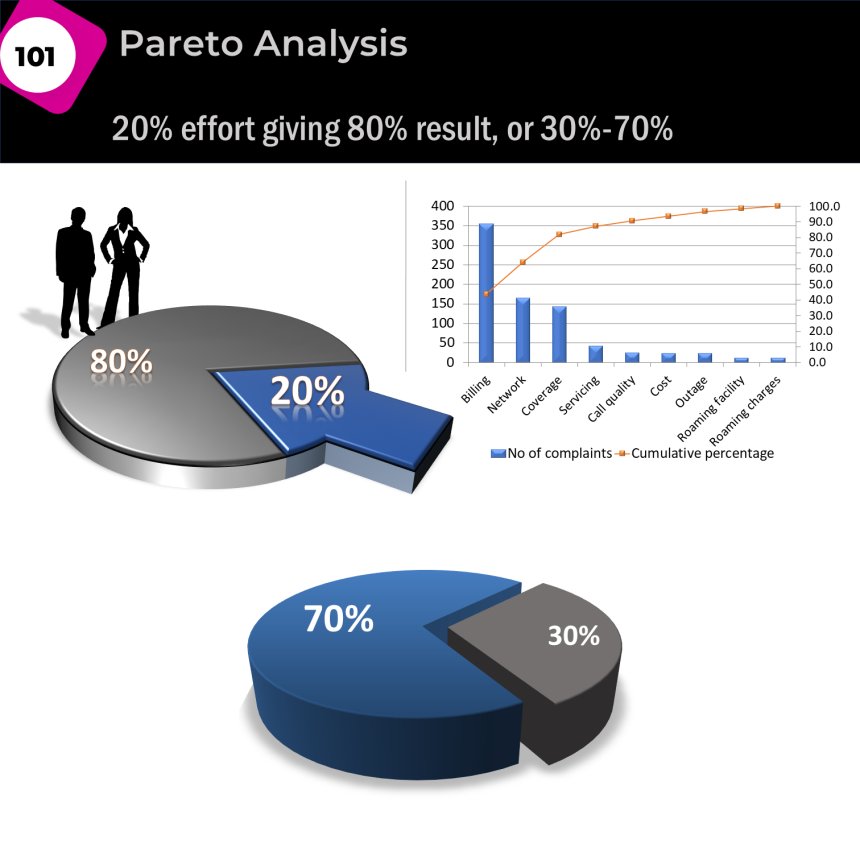
Example: A customer service department receives 500 complaints in a month. Analysis reveals that 320 complaints relate to slow response times, 90 relate to billing errors, 50 relate to product quality, and 40 relate to delivery issues. The Pareto Chart shows that slow response times alone account for 64% of complaints. Rather than spreading resources across all issues, management prioritises response-time improvements first.
Best Used When
Pareto Analysis is most effective when organisations are faced with numerous issues and need to determine where to focus limited resources. It is particularly useful when large amounts of data are available and management needs an objective basis for prioritisation. The method is commonly used after brainstorming, Fishbone Analysis, or data collection exercises to determine which causes, defects, or issues should be addressed first.
Typical Applications
- Customer complaint analysis.
- Product defect analysis.
- Equipment breakdown analysis.
- Safety incident investigations.
- Service quality improvement.
- Process inefficiency studies.
- Cost reduction initiatives.
- Resource allocation decisions.
Key Benefits
- Identifies the most significant causes of problems.
- Helps focus resources on high-impact issues.
- Supports evidence-based decision making.
- Simplifies complex data into actionable insights.
- Improves efficiency of improvement efforts.
- Enables faster and more measurable results.
- Enhances management prioritisation.
- Reduces waste of time and resources.
- Supports continuous improvement programmes.
- Integrates well with RCA, Lean, Six Sigma, and Operational Excellence methodologies.
JSSB Practitioner Note
Pareto Analysis does not identify root causes by itself; it identifies where to look first. It is therefore most powerful when used together with Fishbone Analysis, Five Whys, and FMEA/FMECA. A useful sequence is:
Pareto Analysis → Fishbone Analysis → Five Whys → FMEA/FMECA
This progression helps organisations move from identifying the most important problems, to understanding their causes, and finally to prioritising risk reduction actions.
Files
Share
 Like
0
Like
0
 Dislike
0
Dislike
0
 Love
0
Love
0
 Funny
0
Funny
0
 Angry
0
Angry
0
 Sad
0
Sad
0
 Wow
0
Wow
0