Capability Alignment: Why Strategy Should Not Stay at Corporate Headquarters
Many organisations assume strategy belongs only at headquarters. Learn how capability alignment, organisational design and operating-unit strategy drive execution, agility and long-term competitiveness.

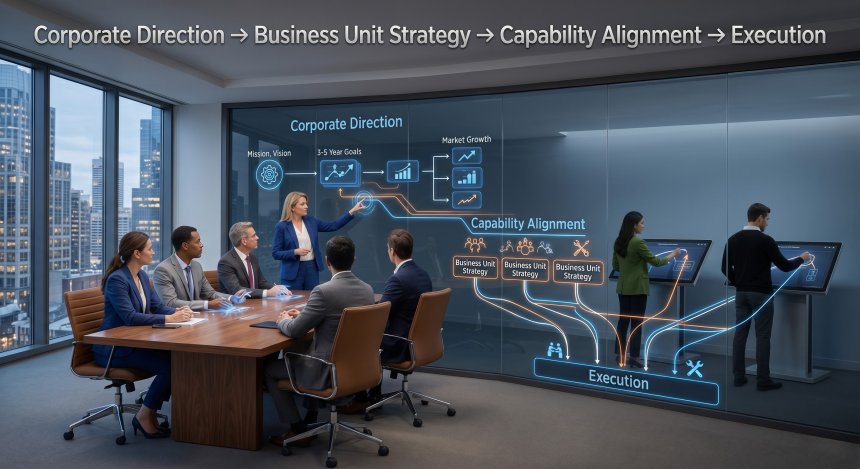

Many organisations assume that strategy belongs at corporate headquarters while operating units are responsible only for execution.
The logic often sounds reasonable:
"Corporate has already developed the strategy. The rest of the organisation simply needs to execute it."
On the surface, this appears disciplined and efficient.
In practice, however, it is often one of the hidden causes of poor execution, slow decision-making, weak accountability, and failed transformation efforts.
The issue is not that corporate strategy is unimportant. Every organisation needs a clear enterprise direction.
The problem arises when strategy is treated as something that exists exclusively at the top of the organisation while the rest of the business is expected to operate without strategic ownership.
This is not merely a leadership issue.
It is an organisational design issue.
More specifically, it is a capability alignment issue.
What Is Capability Alignment?
Capability alignment is the process of ensuring that an organisation's structure, decision-making authority, competencies, systems, resources, and leadership capabilities support the outcomes it is expected to deliver.
In simple terms, capability alignment ensures that people have both the responsibility and the ability to achieve the results they are accountable for.
Many organisations spend considerable effort developing strategic plans, annual business plans, transformation roadmaps, and performance targets. Yet they often overlook a critical question:
Do the people responsible for delivering these outcomes possess the authority, capabilities, and strategic decision-making rights required to succeed?
When the answer is no, it creates a gap between ambition and execution.
Capability alignment closes that gap.
Why Strategy Cannot Remain at Headquarters
Large organisations are designed in layers.
There is typically a corporate centre supported by business units, subsidiaries, regional operations, product divisions, functional departments, and project teams.
Many of these operating units manage substantial revenue, oversee large workforces, serve different customer segments, compete against different competitors, and operate within distinct market conditions.
To tell these units, "Do not concern yourself with strategy; simply execute," is to misunderstand what strategy actually means.
If an organisation expects a business unit to deliver growth, profitability, customer value, operational excellence, risk management, innovation, and transformation outcomes, then that business unit must possess the capability to make strategic choices within its own operating environment.
Otherwise, the organisation has created a mismatch between accountability and authority.
People become responsible for results they are not empowered to influence.
That is not alignment.
That is structural dysfunction.
Corporate Strategy vs Operating Unit Strategy
A common misconception is that having a corporate strategy means other levels of the organisation no longer need one.
In reality, different levels of the organisation answer different strategic questions.
Corporate strategy focuses on enterprise-level choices:
- Where should the organisation compete?
- Which businesses should we be in?
- Where should capital be allocated?
- Which investments create the greatest value?
- What enterprise capabilities must be developed?
- What risks must be managed across the portfolio?
These are essential questions.
But they are not the same questions facing business-unit leaders.
Operating-unit strategy addresses issues such as:
- How do we win in this market?
- How do we serve this customer segment more effectively?
- How do we increase revenue and profitability?
- How do we improve operational performance?
- How do we respond to local competitors?
- What capabilities must we build?
- Which activities should we prioritise, stop, or redesign?
Corporate strategy establishes direction.
Operating-unit strategy translates that direction into winning choices within a specific business reality.
Alignment does not mean the absence of strategy at lower levels.
Alignment means ensuring that all strategies support a common enterprise direction.
The Organisational Design Problem
This is where many organisations encounter difficulty.
When strategy is centralised while accountability is distributed, an imbalance emerges.
Business units are expected to deliver outcomes, yet major decisions remain concentrated at the centre.
Managers are expected to lead transformation, yet strategic thinking is reserved for a small group at headquarters.
Over time, this creates organisational friction.
Decision-making slows.
Escalation increases.
Innovation declines.
Ownership weakens.
Transformation efforts become administrative exercises rather than genuine business improvements.
From an organisational design perspective, three elements must remain aligned:
- Accountability
- Authority
- Capability
When one of these is missing, performance inevitably suffers.
A Useful Analogy: Football
Consider football.
A national football association may have a long-term strategy covering talent development, coaching standards, league structures, funding priorities, and international performance targets.
That strategy is important.
But no one would suggest that a coach no longer needs a strategy.
The coach must still decide:
- Who starts the match?
- Which formation should be used?
- Should the team play aggressively or defensively?
- How should the opposition be neutralised?
- When should tactics change?
The football association provides the direction.
The coach develops the match strategy.
Both are necessary.
Both must be aligned.
No one would say:
"The association already has a strategy. Just get the players to kick the ball and win."
That would be absurd.
Yet many organisations unintentionally operate in exactly this manner.
Signs of Poor Capability Alignment
The consequences of poor capability alignment are often visible long before performance declines.
Common warning signs include:
- Decisions constantly escalated to headquarters
- Slow responses to customer needs and market changes
- Excessive reliance on approval processes
- Conflicting priorities across departments
- Transformation fatigue
- Weak ownership of outcomes
- Leaders focused primarily on reporting rather than decision-making
- Limited innovation despite high levels of activity
- Delayed execution of strategic initiatives
- Frustration among managers responsible for delivery
When these symptoms become widespread, the root cause is often not capability alone.
It is the misalignment between capability, authority, and accountability.
How Transformation Leaders Create Capability Alignment
Transformation is frequently misunderstood as a collection of initiatives, workshops, dashboards, and milestone reviews. How does Transformation Leaders create Capability Alignment?
Those activities are important, but they are not the essence of transformation.
At its core, transformation is about designing the future organisation.
That includes determining:
- Where decisions should be made
- What capabilities should exist at each level
- How authority should be distributed
- What leadership behaviours are required
- How departments should be structured
- How work should flow across the organisation
- Which competencies must be developed
Transformation leaders therefore play a critical role in capability alignment.
Their responsibility is not merely to manage projects.
Their responsibility is to ensure the organisation is capable of delivering its future strategy.
A practical approach includes:
1. Clarify Enterprise Direction
Ensure strategic priorities are clearly understood across the organisation.
2. Define Strategic Responsibilities
Identify which strategic decisions belong at corporate, business-unit, functional, and operational levels.
3. Align Decision Rights
Ensure authority exists where accountability resides.
4. Build Required Capabilities
Develop the competencies, systems, structures, and resources needed to execute effectively.
5. Measure Outcomes
Track results, learn continuously, and adjust where necessary.
A Practical Capability Alignment Framework
Capability alignment can be viewed through five interconnected questions:
Direction
Where are we going?
Choices
How will we win?
Capabilities
What must we be good at?
Structure
Who owns what?
Execution
How do we measure success?
When these five elements are aligned, strategy becomes actionable rather than aspirational.
The Real Goal: Alignment, Not Centralisation
If strategy is allowed to exist only at headquarters, organisations often become increasingly centralised and top-heavy.
Strategic thinking becomes concentrated within a small group while operating units become execution engines.
This creates bottlenecks, weakens responsiveness, discourages initiative, and distances leadership from market realities.
Conversely, if every unit develops independent strategies without alignment, the organisation becomes fragmented and difficult to coordinate.
The objective is not to choose one extreme or the other.
The objective is to create a system where both can coexist.
Corporate strategy establishes enterprise direction.
Operating-unit strategy converts that direction into practical choices within specific operating realities.
Both are essential.
Both must be aligned.
Conclusion
Capability alignment is what connects strategy to execution.
It ensures that every level of the organisation possesses the authority, competencies, resources, and accountability required to deliver results.
Organisations that centralise all strategic thinking at headquarters often become slower, more bureaucratic, and less responsive to changing market conditions.
Organisations that decentralise without alignment become fragmented and inconsistent.
The strongest organisations avoid both extremes.
They build:
- One enterprise direction
- Many aligned strategies
- Clear capability ownership
- Effective decision rights
- Disciplined execution across every layer
That is the essence of capability alignment.
And ultimately, that is one of the most important principles of effective organisational design.
Many organisations assume that strategy belongs at corporate headquarters while operating units are responsible only for execution.
The logic often sounds reasonable:
"Corporate has already developed the strategy. The rest of the organisation simply needs to execute it."
On the surface, this appears disciplined and efficient.
In practice, however, it is often one of the hidden causes of poor execution, slow decision-making, weak accountability, and failed transformation efforts.
The issue is not that corporate strategy is unimportant. Every organisation needs a clear enterprise direction.
The problem arises when strategy is treated as something that exists exclusively at the top of the organisation while the rest of the business is expected to operate without strategic ownership.
This is not merely a leadership issue.
It is an organisational design issue.
More specifically, it is a capability alignment issue.
What Is Capability Alignment?
Capability alignment is the process of ensuring that an organisation's structure, decision-making authority, competencies, systems, resources, and leadership capabilities support the outcomes it is expected to deliver.
In simple terms, capability alignment ensures that people have both the responsibility and the ability to achieve the results they are accountable for.
Many organisations spend considerable effort developing strategic plans, annual business plans, transformation roadmaps, and performance targets. Yet they often overlook a critical question:
Do the people responsible for delivering these outcomes possess the authority, capabilities, and strategic decision-making rights required to succeed?
When the answer is no, it creates a gap between ambition and execution.
Capability alignment closes that gap.
Why Strategy Cannot Remain at Headquarters
Large organisations are designed in layers.
There is typically a corporate centre supported by business units, subsidiaries, regional operations, product divisions, functional departments, and project teams.
Many of these operating units manage substantial revenue, oversee large workforces, serve different customer segments, compete against different competitors, and operate within distinct market conditions.
To tell these units, "Do not concern yourself with strategy; simply execute," is to misunderstand what strategy actually means.
If an organisation expects a business unit to deliver growth, profitability, customer value, operational excellence, risk management, innovation, and transformation outcomes, then that business unit must possess the capability to make strategic choices within its own operating environment.
Otherwise, the organisation has created a mismatch between accountability and authority.
People become responsible for results they are not empowered to influence.
That is not alignment.
That is structural dysfunction.
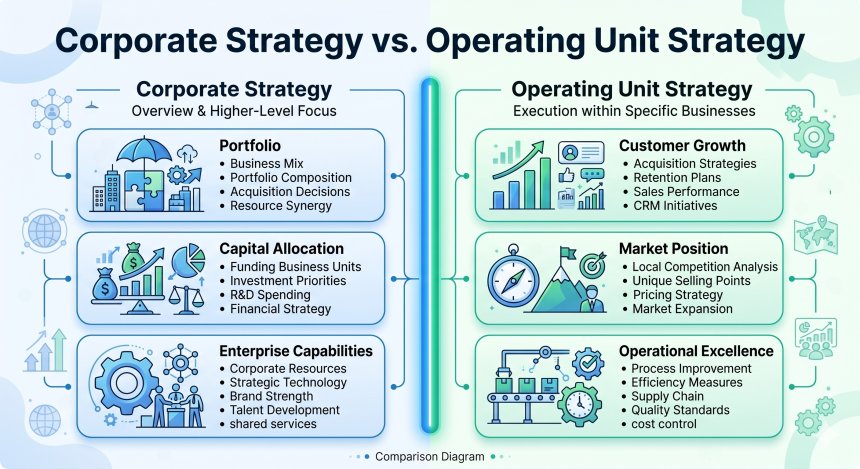
Corporate Strategy vs Operating Unit Strategy
A common misconception is that having a corporate strategy means other levels of the organisation no longer need one.
In reality, different levels of the organisation answer different strategic questions.
Corporate strategy focuses on enterprise-level choices:
- Where should the organisation compete?
- Which businesses should we be in?
- Where should capital be allocated?
- Which investments create the greatest value?
- What enterprise capabilities must be developed?
- What risks must be managed across the portfolio?
These are essential questions.
But they are not the same questions facing business-unit leaders.
Operating-unit strategy addresses issues such as:
- How do we win in this market?
- How do we serve this customer segment more effectively?
- How do we increase revenue and profitability?
- How do we improve operational performance?
- How do we respond to local competitors?
- What capabilities must we build?
- Which activities should we prioritise, stop, or redesign?
Corporate strategy establishes direction.
Operating-unit strategy translates that direction into winning choices within a specific business reality.
Alignment does not mean the absence of strategy at lower levels.
Alignment means ensuring that all strategies support a common enterprise direction.
The Organisational Design Problem
This is where many organisations encounter difficulty.
When strategy is centralised while accountability is distributed, an imbalance emerges.
Business units are expected to deliver outcomes, yet major decisions remain concentrated at the centre.
Departments are expected to improve performance, yet they lack the authority to redesign processes, deploy resources, or build capabilities.
Managers are expected to lead transformation, yet strategic thinking is reserved for a small group at headquarters.
Over time, this creates organisational friction.
Decision-making slows.
Escalation increases.
Innovation declines.
Ownership weakens.
Transformation efforts become administrative exercises rather than genuine business improvements.
From an organisational design perspective, three elements must remain aligned:
- Accountability
- Authority
- Capability
When one of these is missing, performance inevitably suffers.
A Useful Analogy: Football
Consider football.
A national football association may have a long-term strategy covering talent development, coaching standards, league structures, funding priorities, and international performance targets.
That strategy is important.
But no one would suggest that a coach no longer needs a strategy.
The coach must still decide:
- Who starts the match?
- Which formation should be used?
- Should the team play aggressively or defensively?
- How should the opposition be neutralised?
- When should tactics change?
The football association provides the direction.
The coach develops the match strategy.
Both are necessary.
Both must be aligned.
No one would say:
"The association already has a strategy. Just get the players to kick the ball and win."
That would be absurd.
Yet many organisations unintentionally operate in exactly this manner.

Signs of Poor Capability Alignment
The consequences of poor capability alignment are often visible long before performance declines.
Common warning signs include:
- Decisions constantly escalated to headquarters
- Slow responses to customer needs and market changes
- Excessive reliance on approval processes
- Conflicting priorities across departments
- Transformation fatigue
- Weak ownership of outcomes
- Leaders focused primarily on reporting rather than decision-making
- Limited innovation despite high levels of activity
- Delayed execution of strategic initiatives
- Frustration among managers responsible for delivery
When these symptoms become widespread, the root cause is often not capability alone.
It is the misalignment between capability, authority, and accountability.
How Transformation Leaders Create Capability Alignment
Transformation is frequently misunderstood as a collection of initiatives, workshops, dashboards, and milestone reviews. How does Transformation Leaders create Capability Alignment?
Those activities are important, but they are not the essence of transformation.
At its core, transformation is about designing the future organisation.
That includes determining:
- Where decisions should be made
- What capabilities should exist at each level
- How authority should be distributed
- What leadership behaviours are required
- How departments should be structured
- How work should flow across the organisation
- Which competencies must be developed
Transformation leaders therefore play a critical role in capability alignment.
Their responsibility is not merely to manage projects.
Their responsibility is to ensure the organisation is capable of delivering its future strategy.
A practical approach includes:
1. Clarify Enterprise Direction
Ensure strategic priorities are clearly understood across the organisation.
2. Define Strategic Responsibilities
Identify which strategic decisions belong at corporate, business-unit, functional, and operational levels.
3. Align Decision Rights
Ensure authority exists where accountability resides.
4. Build Required Capabilities
Develop the competencies, systems, structures, and resources needed to execute effectively.
5. Measure Outcomes
Track results, learn continuously, and adjust where necessary.
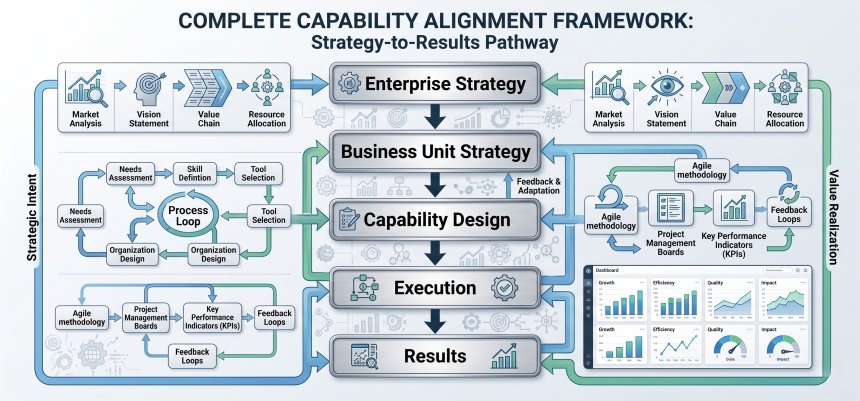
A Practical Capability Alignment Framework
Capability alignment can be viewed through five interconnected questions:
Direction
Where are we going?
Choices
How will we win?
Capabilities
What must we be good at?
Structure
Who owns what?
Execution
How do we measure success?
When these five elements are aligned, strategy becomes actionable rather than aspirational.
The Real Goal: Alignment, Not Centralisation
If strategy is allowed to exist only at headquarters, organisations often become increasingly centralised and top-heavy.
Strategic thinking becomes concentrated within a small group while operating units become execution engines.
This creates bottlenecks, weakens responsiveness, discourages initiative, and distances leadership from market realities.
Conversely, if every unit develops independent strategies without alignment, the organisation becomes fragmented and difficult to coordinate.
The objective is not to choose one extreme or the other.
The objective is to create a system where both can coexist.
Corporate strategy establishes enterprise direction.
Operating-unit strategy converts that direction into practical choices within specific operating realities.
Both are essential.
Both must be aligned.
Conclusion
Capability alignment is what connects strategy to execution.
It ensures that every level of the organisation possesses the authority, competencies, resources, and accountability required to deliver results.
Organisations that centralise all strategic thinking at headquarters often become slower, more bureaucratic, and less responsive to changing market conditions.
Organisations that decentralise without alignment become fragmented and inconsistent.
The strongest organisations avoid both extremes.
They build:
- One enterprise direction
- Many aligned strategies
- Clear capability ownership
- Effective decision rights
- Disciplined execution across every layer
That is the essence of capability alignment.
And ultimately, that is one of the most important principles of effective organisational design.
Share
 Like
1
Like
1
 Dislike
0
Dislike
0
 Love
0
Love
0
 Funny
0
Funny
0
 Angry
0
Angry
0
 Sad
0
Sad
0
 Wow
2
Wow
2