Target Operating Model (TOM) with AI Capabilities
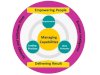
AI-enabled Target Operating Model (TOM) framework that combines AI, value-chain engineering, KPI systems, and culture alignment to redesign and operationalise high-performance organisations.

What is Target Operating Model?
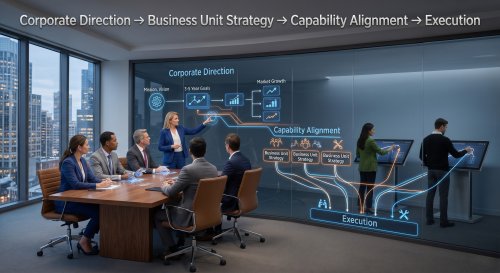
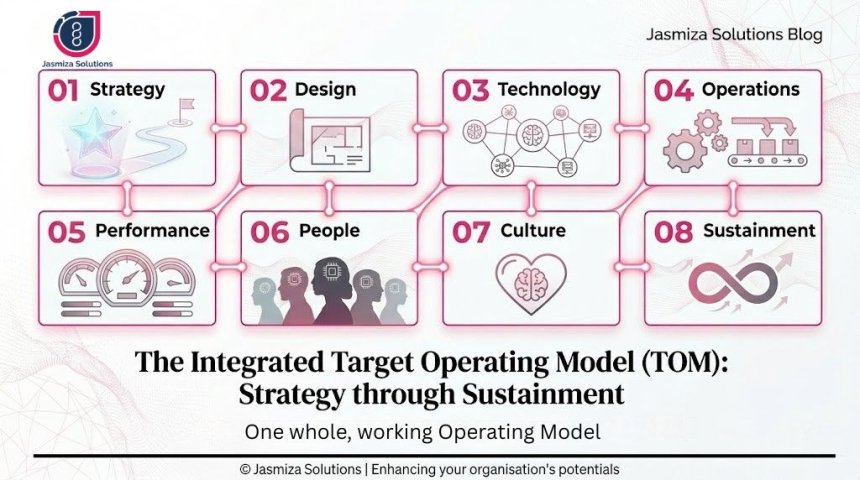
A Target Operating Model (TOM) defines how an organisation should operate in the future to deliver its strategy effectively. It aligns people, processes, technology, and governance into a coherent system that enables execution at scale. When enhanced with AI capabilities, a TOM becomes an intelligent operating model—one that not only executes but also predicts, adapts, and optimises decisions in real time. This is increasingly critical as organisations face complexity, cost pressure, and the need for speed in decision-making.
In practical terms, an AI-enabled TOM transforms traditional workflows into data-driven, automated, and adaptive systems. Processes are redesigned with embedded intelligence, decision-making is augmented with predictive insights, and performance management shifts from lagging indicators to real-time control. Organisations that adopt this approach are able to improve efficiency, enhance customer outcomes, and build scalable operations that remain resilient in changing environments.
For companies running facility management, healthcare support, maintenance-heavy operations, AI agentics should not be treated as a layer of automation—it must be embedded into the operating model itself, particularly across asset reliability, workforce deployment, and service quality control.
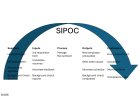
In a traditional value chain for facility management and healthcare support services, the value chain is linear and reactive—service request, manual triage, assignment, execution, and reporting—heavily dependent on supervisor judgement, fragmented data, and delayed decision-making, resulting in suboptimal asset reliability, low workforce utilisation, and inconsistent SLA performance. In an AI-enabled TOM, this shifts to an intelligent, integrated value chain where requests are contextually interpreted, prioritised, and allocated using predictive and optimisation models, workflows are automated end-to-end, and real-time monitoring enables proactive intervention, improving equipment uptime, increasing wrench time, and ensuring consistent, high-quality service delivery across critical healthcare environments.
Design AI-enabled Target Operating Model
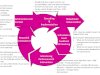
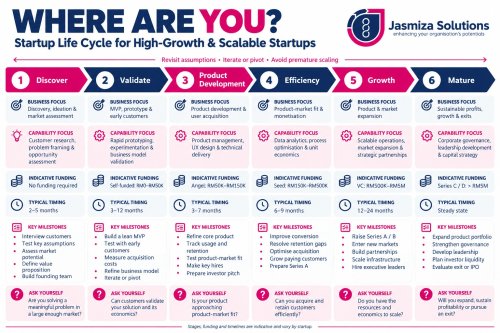
For another different operating model + AI enabled example, 
With over 20 years of experience across more than 200 organisations, Jasmiza Solutions (JSSB) has developed deep expertise in value chain engineering, operational excellence, and performance systems. Unlike conventional consulting approaches that stop at design, JSSB focuses on translating strategy into executable systems—ensuring that operating models are not only well-designed but also fully operationalised. This positions JSSB uniquely to support organisations in redesigning their operating models, integrating AI capabilities, and embedding performance discipline at every level.
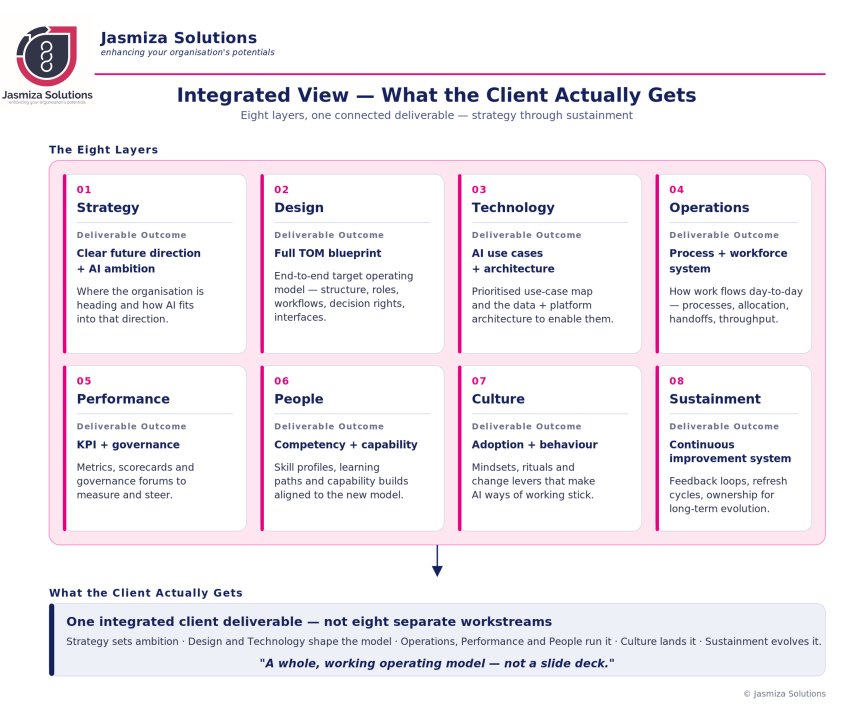
The JSSB approach integrates TOM design with execution through a structured method: starting with defining strategic intent and AI ambition, followed by diagnosing the current operating model and readiness, then designing the future-state operating model across capability, process, organisation, technology, and governance layers. This is complemented by a transition roadmap that bridges current to future state, and an execution engine that embeds process optimisation, KPI systems, and behavioural alignment. The result is a fully integrated operating system—where strategy, operations, and intelligence work together to deliver sustained organisational performance.
How Jasmiza Solutions drives AI-enabled Target Operating Model
Our deliverables from training, consulting and project lead:
Share
 Like
1
Like
1
 Dislike
0
Dislike
0
 Love
0
Love
0
 Funny
0
Funny
0
 Angry
0
Angry
0
 Sad
0
Sad
0
 Wow
2
Wow
2