Managing Emotionals are as Objective as Managing Numbers
Managing Emotions After Restructuring, Transformation is not just a plan to achieve numbers. After restructuring, numbers alone are not enough. Learn why managers must address emotions and how to hold a humane emotion check meeting. It can leave employees uncertain, overloaded, or reluctant to speak openly. This article explains why managers need to treat emotions as part of performance management, not as weakness,and offers JSSB’s practical approach to holding a humane emotion check meeting.

Managers are expected to interpret margins, forecast cash flow, manage cost, and explain performance. Yet when a restructuring, difficult target, missed forecast, or technology change triggers fear, grief, anger, uncertainty, or exhaustion, many managers have far less preparation. That gap matters: numbers tell us what happened; emotions strongly shape what people do next.
Treating feelings as weakness is not a mark of high standards. It is a management blind spot. In periods of change, emotions are not separate from execution—they affect attention, judgment, collaboration, trust, retention, and the willingness to speak up when risks emerge.
“Numbers tell us what happened. Judgment decides what it means and what to do next.”
The management skill gap
Many management systems still promote people primarily because they are strong technical contributors: they can deliver results, solve problems, control risk, or manage complex operations. Their training commonly reinforces planning, reporting, budgeting, KPIs, and performance conversations.
Those capabilities are essential. But they are incomplete.
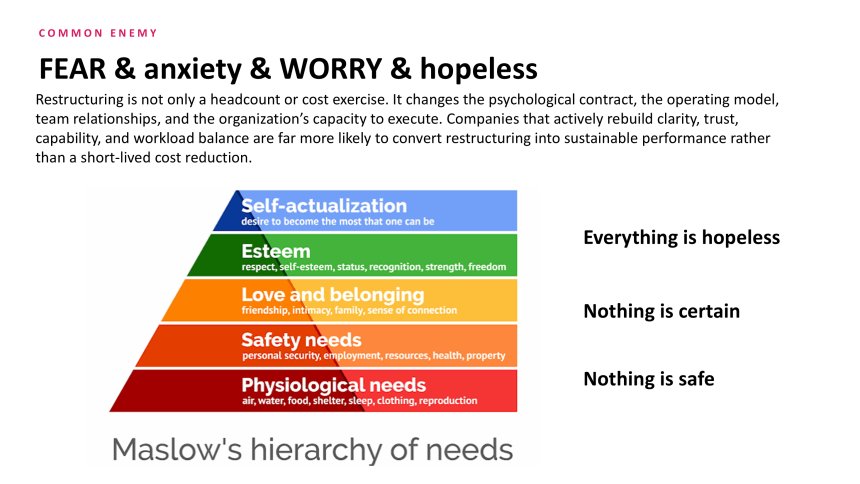
Managers also become the organization’s closest interpreters of change. Employees watch them to understand whether a restructuring is manageable, whether workload expectations are realistic, whether it is safe to raise concerns, and whether leaders genuinely care about people—not only outputs. A manager who can explain the numbers but cannot recognize a team’s anxiety, frustration, or loss leaves a critical part of the work unmanaged.
The problem is often cultural rather than intentional. Feelings may be dismissed with familiar phrases:
-
“Let’s be professional.”
-
“Don’t take it personally.”
-
“We need to move on.”
-
“Focus on the facts.”
-
“Emotions are not helpful right now.”
But emotions are already present, whether leaders name them or not. Ignoring them does not remove them; it drives them underground, where they can appear as silence, disengagement, resistance, conflict, absenteeism, burnout, or unwanted turnover.
This is particularly visible after cost optimization or restructuring. Remaining employees may be relieved to retain their roles while also grieving colleagues, worrying about the next change, and struggling with a heavier workload. These are not contradictory reactions. They are normal human responses to uncertainty and loss.
Feelings are data, not weakness
Effective emotional management does not mean turning managers into therapists, avoiding accountability, or allowing every decision to be determined by mood. It means treating emotional signals as important information about the conditions under which people must perform.
For example:
A financially disciplined manager asks: What is driving the variance?
An emotionally intelligent manager asks: What is driving the reaction?
Both questions are diagnostic. Both are necessary for good decisions.
Emotions can point to real operating risks. Fear may signal unclear job security or unrealistic demands. Anger may signal perceived unfairness or a breakdown in trust. Exhaustion may be an early warning that capacity has not been redesigned after responsibilities were consolidated. Apathy may indicate that employees no longer believe their effort will make a difference.
The managerial task is not to agree automatically with every interpretation. It is to listen, understand, acknowledge the experience, clarify what is true, and act on what can be changed.
Why it matters more now
Managing emotions has always been part of leadership. It is more urgent now because work is becoming more volatile, more technology-enabled, and more psychologically demanding.
The World Economic Forum estimates that structural labour-market transformation could affect 22% of jobs by 2030, driven by technology, economic pressure, demographic change, and geopolitical shifts. At the same time, employers continue to rank resilience, flexibility, agility, leadership, social influence, empathy, and active listening among the capabilities needed alongside technical expertise.weforum+1
This changes the job of a manager.
AI and automation can reconcile transactions, flag anomalies, generate reports, and draft commentary. But they cannot own the judgment involved in balancing financial evidence with human consequences. They cannot reliably read the emotional temperature of a team, rebuild trust after difficult decisions, make a colleague feel heard, or take accountability for a decision’s impact.
That makes human leadership more—not less—valuable.
The strain is also affecting managers themselves. Gallup’s 2026 global workplace findings report that manager engagement has declined by nine percentage points since 2022, with the largest year-over-year decline occurring between 2024 and 2025. Managers who are not supported may carry their own stress, uncertainty, and workload into the teams they lead.gallup
This creates a compounding risk:
-
The organization changes structure, targets, technology, or expectations.
-
Managers absorb pressure while trying to maintain delivery.
-
Employees look to them for clarity and reassurance.
-
Managers who lack emotional-management skills default to avoidance, over-control, or “business as usual.”
-
Trust declines, concerns remain unspoken, and execution becomes harder.
Managing emotions is therefore not a wellbeing initiative that sits beside performance. It is a core operating capability for organizations navigating transformation.
The cost of treating emotion as irrelevant
When leaders treat emotional reactions as weakness, they often unintentionally make them stronger.
A team that has not had space to acknowledge loss after a restructuring may continue to operate in survival mode. Its members may protect themselves rather than collaborate, withhold ideas rather than take risks, and focus on immediate self-preservation rather than shared outcomes. The organization may achieve a short-term cost reduction while quietly losing discretionary effort, institutional memory, and critical talent.
Gallup’s research reinforces the importance of the manager’s role: managers account for at least 70% of the variance in team engagement. Its analysis of more than 180,000 manager-led teams also finds that more engaged managers tend to lead more engaged teams, which are associated with better quality and quantity of output, more positive daily experiences, and higher overall thriving.gallup+1
The implication is straightforward: managers cannot be expected to create engagement, clarity, and resilience for others if they have not been equipped to manage the human side of change.
A manager who responds to distress only with a new dashboard may miss the issue. A dashboard can show declining productivity or rising absence. It cannot, on its own, tell leaders whether the source is workload, lack of role clarity, loss of trust, grief after colleagues leave, or fear that speaking honestly will be punished.
What emotionally capable managers do
Emotionally capable management is practical, observable, and learnable. It does not require perfect empathy or dramatic displays of vulnerability. It requires disciplined habits.
1. Check in before jumping to solutions
Begin important conversations with a genuine question:
“How are you experiencing the changes—not just the workload, but the change itself?”
Listen for both facts and feelings. Employees do not need their manager to solve everything immediately. They need evidence that the manager sees the reality they are working in.
2. Name the reality without overpromising
After change, vague reassurance can damage trust. Avoid promising “there will be no more changes” unless it can genuinely be guaranteed.
Instead, say:
“I know the uncertainty is difficult. Here is what we know, here is what we do not yet know, and this is when I will update you next.”
Clarity does not remove all anxiety, but it gives people something reliable to hold onto.
3. Validate without surrendering accountability
Validation is not agreement. A manager can acknowledge an employee’s experience and still hold standards.
For example:
“It makes sense that you feel overwhelmed. Your responsibilities changed quickly and the team is smaller. Let’s identify what must be delivered, what can stop, and what support or decisions you need from me.”
This moves the conversation from emotion alone to action.
4. Reset workload, priorities, and expectations
After restructuring, work rarely disappears in proportion to headcount. Tasks often accumulate around the remaining employees. Managers should conduct a capacity and workload review rather than simply redistribute work.
Ask:
-
What work is mission-critical?
-
What can stop, pause, simplify, automate, or redesign?
-
Which decisions have become unclear?
-
Which KPIs need transitional adjustment?
-
What is the team expected to deprioritize?
Gallup identifies manager practices such as listening to work-related problems, encouraging peer support, inviting employee input, connecting work to purpose, and using strengths-based feedback as actions that can help prevent or reduce burnout.
5. Build regular two-way conversations
A single town hall is not enough. Trust is rebuilt in repeated, local interactions: team meetings, one-to-ones, listening sessions, and visible follow-through.
A simple rhythm can help:
-
Check in: What are people experiencing?
-
Converse: What is the impact on work, relationships, workload, and confidence?
-
Check out: What is one concrete next step, owner, and follow-up date?
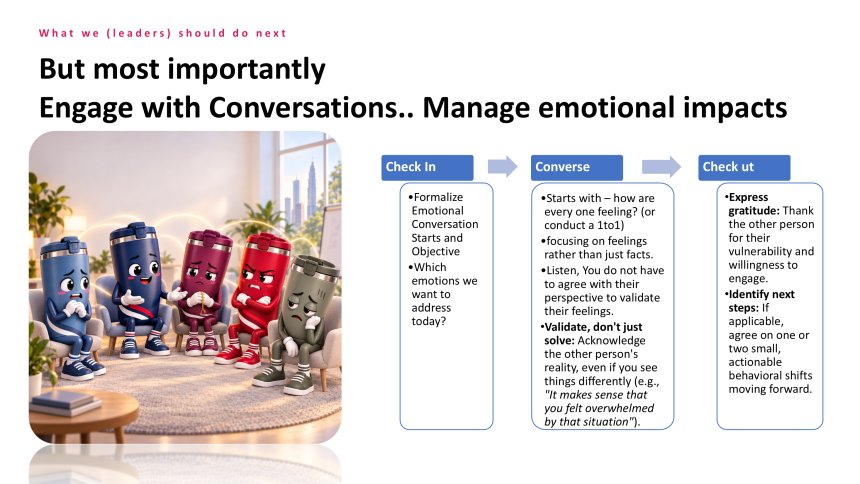
The goal is not to make every employee happy. The goal is to ensure people are heard, risks are surfaced early, and commitments are clear.
6. Support managers before asking them to support everyone else
Managers are often asked to communicate change, handle difficult questions, maintain performance, and retain talent—while receiving limited context, authority, or coaching. Organizations should not assume that technical competence automatically translates into emotional leadership.
Invest in manager development that builds the ability to:
-
Recognize emotional cues without diagnosing people.
-
Hold difficult, respectful conversations.
-
Communicate uncertainty honestly.
-
Validate experiences while maintaining standards.
-
Identify burnout and workload risks early.
-
Escalate issues appropriately.
-
Translate organizational change into practical team priorities.
Gallup recommends developing managers as performance coaches, equipping them to create role clarity, provide meaningful conversations and feedback, recognize progress, support employees as whole people, and promote psychological safety.
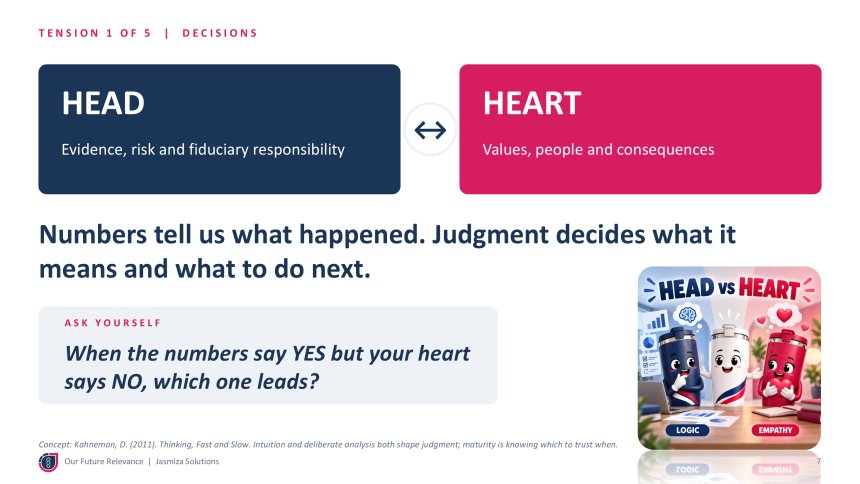
The leadership choice
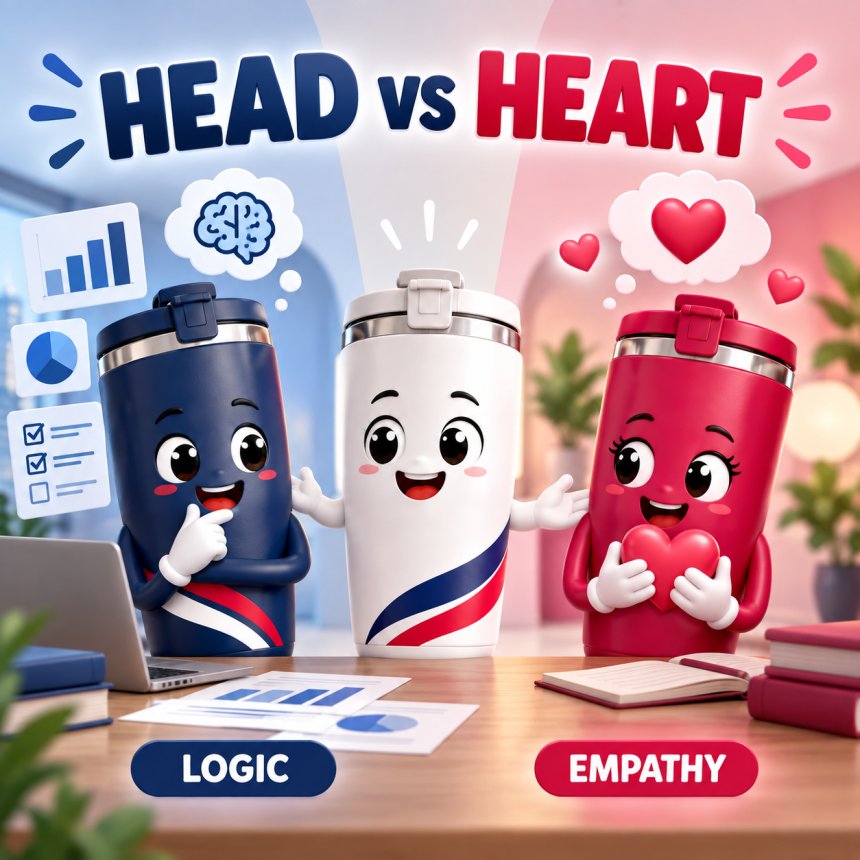
The most effective leaders do not choose between head and heart. They understand that each is needed at different moments.
The head brings evidence, financial discipline, risk management, and operational rigour. The heart brings values, empathy, awareness of consequences, and the ability to maintain human connection under pressure. Numbers can reveal that costs need to change. Human judgment determines how the change is carried out, what harm can be reduced, and whether the organization retains the trust and capability required to perform afterward.
The question for leaders is not whether emotions belong at work. They already shape work every day.
The real question is whether managers will be trained and trusted to manage them as deliberately as they manage budgets, timelines, and performance indicators.
In a world where technology can increasingly produce numbers and first drafts, the distinctly human responsibilities of judgment, ethics, context, accountability, and influence become more important. Managing emotions is not a soft alternative to managing numbers. It is one of the conditions that makes strong numerical performance sustainable.
Head and heart belong together
An emotion check cannot substitute for sound business decisions. If fewer people are doing more work, a compassionate conversation without a workload review will ring hollow. Likewise, a perfectly revised KPI will not rebuild trust if employees feel that their concerns are unwelcome.
Leaders need both disciplines: the head to examine evidence, risk, capacity, and financial outcomes; the heart to understand the people asked to deliver those outcomes. The question is not which one should win. It is whether managers know when each is needed—and have been trained to use both.
Managing numbers shows whether a restructuring achieved its immediate target. Managing emotions helps determine whether the organization can sustain the performance it hopes to achieve.
Managing emotions is not a distraction from managing numbers; it is how leaders make the numbers sustainable. After restructuring, employees need more than a revised structure and new targets. They need managers who will listen without judgment, acknowledge what has changed, address unrealistic workloads, and follow through on what they hear. An emotion check meeting cannot remove every uncertainty, but it can replace silence with conversation and help turn concern into practical action. That is not weakness. It is responsible leadership.
Share
 Like
0
Like
0
 Dislike
0
Dislike
0
 Love
0
Love
0
 Funny
0
Funny
0
 Angry
0
Angry
0
 Sad
0
Sad
0
 Wow
0
Wow
0