VUCA, BANI and the Future of Work: Every Generation Has a Seat at the Table
Explore VUCA and BANI and how a multigenerational workforce can embrace AI, build resilience, and navigate the future of work through shared learning.

VUCA, BANI and the Future of Work: Every Generation Has a Seat at the Table
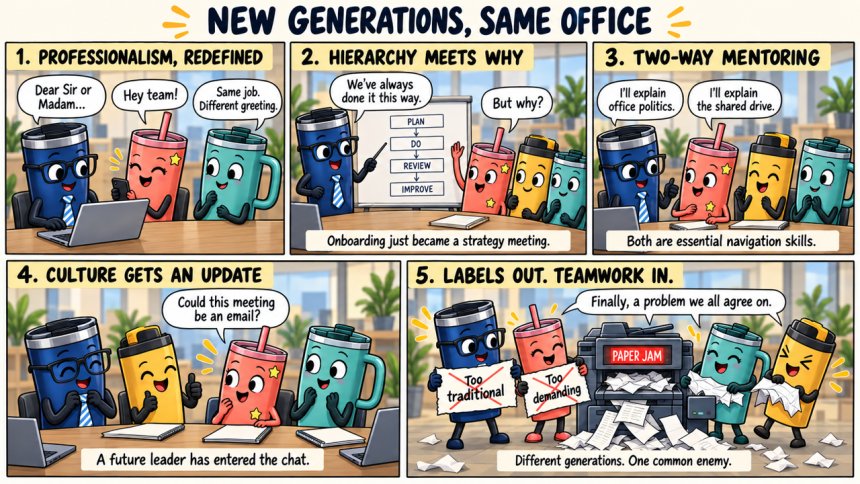
One colleague writes, “Dear Sir or Madam.” Another replies, “Hey team!” A third asks whether the meeting could have been an email.
Then someone introduces a new AI tool, and suddenly everyone shares the same thought:
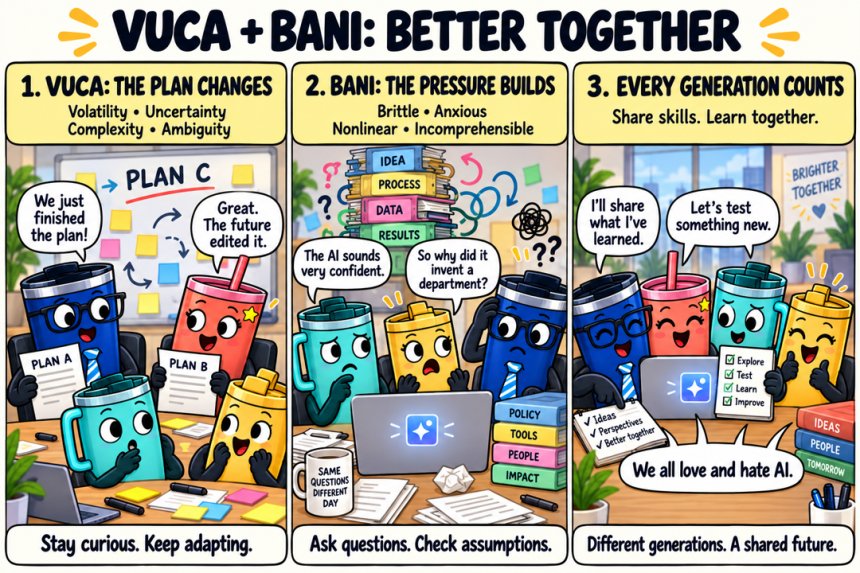
“We all love and hate AI.”
Welcome to the modern workplace, where different generations are navigating a future that rarely waits for anyone to finish the training.
Two frameworks help us describe this experience: VUCA and BANI. Their value is in helping us recognize the challenges ahead—and discuss how to respond together.
VUCA describes four kinds of uncertainty at work.
VUCA stands for Volatility, Uncertainty, Complexity and Ambiguity. It gives us a vocabulary for situations where conditions change quickly, outcomes are hard to predict, factors are interconnected, and information allows different interpretations. Project Management Institute
Imagine a company introducing a new digital service:
-
Volatility: Customer demand changes sharply after launch.
-
Uncertainty: The team cannot confidently forecast adoption.
-
Complexity: Success depends on technology, staff, suppliers and customer behavior.
-
Ambiguity: Low initial usage might indicate poor design, limited awareness or simply a learning curve.
The team needs to work out which problem it faces before choosing a response. Another meeting titled “Alignment” will not necessarily solve all four.
BANI adds a perspective on fragility and the experience of chaos.
Developed by futurist Jamais Cascio, BANI stands for Brittle, Anxious, Nonlinear and Incomprehensible:
-
Brittle: A system appears strong until pressure exposes a hidden weakness.
-
Anxious: Conditions make people fearful of decisions and their consequences.
-
Nonlinear: Effects are disproportionate to their causes or emerge after unexpected delays.
-
Incomprehensible: Processes or events resist clear explanation, even when information is available.
Cascio presents BANI as a way to understand chaos, while cautioning that the framework itself does not provide a ready-made strategy. Jamais Cascio, “Human Responses to a BANI World”
Think of an office where one person understands a critical process. Everything runs beautifully—until that person goes on holiday. That is a useful illustration of brittleness, complete with an out-of-office reply.
For this discussion, VUCA and BANI can serve as complementary perspectives. There is no need to declare that one acronym has officially replaced the other.
Every generation needs permission to be a beginner.
Embracing this future starts with dropping the idea that adaptability belongs to a particular age group.
A younger employee may feel confident exploring a new application but uncertain about handling a difficult client. An experienced employee may navigate that conversation brilliantly while needing help with an unfamiliar interface. The reverse can also be true.
Age is a poor substitute for asking people what they know, what they need and what they would like to learn.
A useful workplace norm is simple: everyone should have something to teach and room to learn.
Make mentoring a two-way conversation.
Pair colleagues around complementary skills and give them a real problem to solve.
One might demonstrate how to use AI to prepare an initial draft. Another might identify missing context, unrealistic assumptions or language likely to confuse a customer. Either role can belong to someone of any generation.
The exchange works best when both people leave with a new capability. “I’ll explain the shared drive; you explain why this client never uses it” is a perfectly respectable starting point.
Turn uncertainty into small, practical experiments.
Teams do not need complete certainty before taking a useful step. They do need boundaries.
Before testing a new approach, agree on the problem, the scope, the evidence of success and when to stop or adjust. Try it on a manageable task, review the result and share what happened.
For an AI writing tool, that could mean testing an internal draft, checking accuracy and tone, and comparing the total time required—including corrections.
The question becomes: “Where does this help us, and what still requires attention?”
That is a more productive conversation than asking everyone to choose between enthusiastic adoption and permanent suspicion.
Build workplaces where people can ask for help.
“Be resilient” means little when employees lack training, time or support.
Leaders can make adaptation practical by protecting learning time, explaining the reasons for changes, documenting essential processes and ensuring more than one person can perform critical work.
They can also make it easier to say:
“I don’t understand this yet.”
“I think this result is wrong.”
“We need to reconsider this decision.”
Those statements give a team information it can act on. Silence gives it very little.
Keep human judgment in the conversation.
Embracing the future should include curiosity, scrutiny and the freedom to question a tool or practice.
Before using an AI output, teams can ask whether it is accurate, appropriate for the audience and suitable for the decision involved. Responsibility should remain clear even when technology contributes to the work.
The colleague who spots the mistake is contributing just as much as the colleague who finds the shortcut.
Whatever their age, both deserve a seat at the table.
The next time change arrives at work, a useful opening question is: “What can we help one another learn?”
Someone can bring experience. Someone can bring a fresh perspective. Everyone can bring curiosity.
And when AI produces a beautiful answer to the wrong question, the whole team can share a laugh—then get to work improving it.
VUCA, BANI, Future of Work, Multigenerational Workforce, Workplace Culture, AI in the Workplace, Lifelong Learning, Resilience, Leadership, Collaboration
Share
 Like
0
Like
0
 Dislike
0
Dislike
0
 Love
0
Love
0
 Funny
0
Funny
0
 Angry
0
Angry
0
 Sad
0
Sad
0
 Wow
0
Wow
0