The Digital Agenda Illusion: Why Technology Alone Fails to Deliver Productivity and Growth
A real-world case study on enterprise transformation in a USD10B organization, demonstrating why digital initiatives fail without strong operational foundations. Learn how a zero-budget, system-focused approach outperformed a multi-million dollar digital program by prioritizing process, integration, and data discipline.

You can accelerate adoption, deployment, and visible outcomes—but you can’t skip the fundamentals.
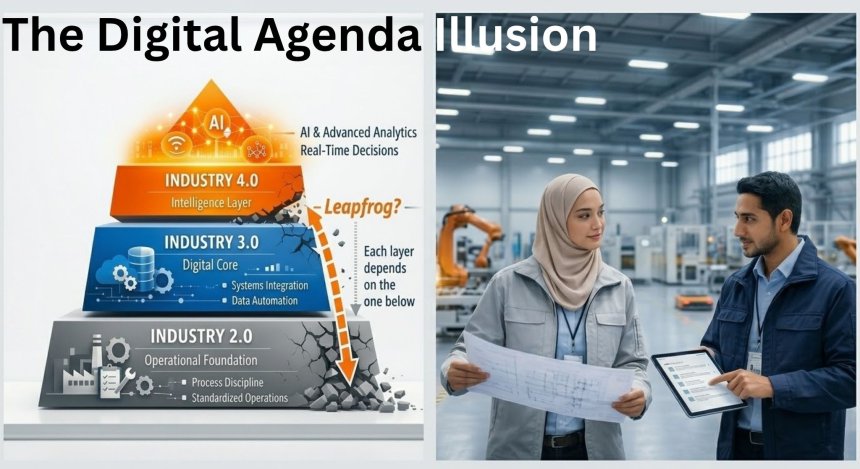
What many companies call “leapfrogging to Industry 4.0” is often just buying 4.0-looking tools—apps, AI, dashboards—on top of a 2.0 foundation of manual, siloed, and inconsistent processes. That doesn’t work. At least not sustainably.
Why You Can’t Leapfrog to Industry 4.0
And What a Zero-Budget Transformation Taught Me About Digital Readiness
Organizations can accelerate adoption.
They can compress implementation timelines.
They can deploy dashboards faster.
But they cannot skip the fundamentals.
In recent years, adopting a “digital agenda” has become almost synonymous with progress. Across industries, organizations are investing heavily in analytics platforms, automation systems, enterprise applications, and artificial intelligence—often with the expectation that technology alone will unlock productivity gains and sustainable growth.
It is an appealing narrative:
If others have succeeded with digital transformation, then surely the answer is to move faster, invest more, and replicate what appears to work.
But this assumption hides a deeper misunderstanding.
Digital transformation is not simply about adopting tools faster.
It is about building organizational capability in the right sequence.
The Misunderstanding Behind “Leapfrogging to Industry 4.0”
Many organizations believe they can leap directly into Industry 4.0 by deploying advanced tools such as:
• AI engines
• analytics dashboards
• mobile enterprise platforms
• predictive systems
• automation technologies
Yet Industry 4.0 is not a technology upgrade.
It is the result of capability maturity.
Industrial transformation has never happened in a single leap. It has always progressed through layers of readiness.
Industry 1.0 introduced mechanization.
Industry 2.0 enabled electrification and scale.
Industry 3.0 brought automation and digital systems.
Industry 4.0 builds on integration, connectivity, and intelligence.
Each stage depends on the strength of the one beneath it.
Transformation Is a Capability Stack — Not a Technology Stack
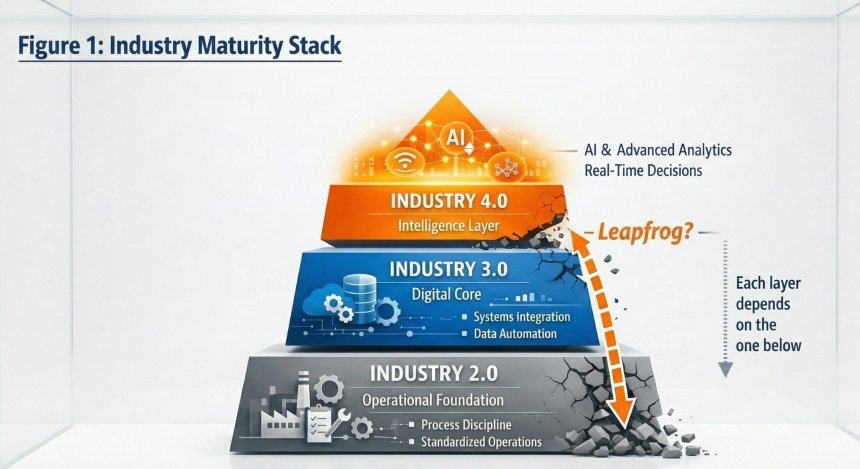
As illustrated in Figure 1, transformation is not a sequence of technologies to be adopted; it is a progression of capabilities to be built. Each layer depends on the integrity of the one beneath it.
Successful transformation follows a predictable structure:
Operational discipline
↓
System integration
↓
Data reliability
↓
Digital intelligence
Remove any one layer, and the transformation becomes unstable.
This is why some organizations appear digitally advanced externally—but internally struggle to deliver consistent performance improvements.
A Real Experience Inside a Large Enterprise Transformation Effort
I encountered this reality firsthand in a large enterprise environment where a major digital initiative was launched with strong leadership visibility and several million dollars in investment.
A dedicated transformation team was established.
A technology-led roadmap was defined.
Expectations were high.
From the outside, the initiative appeared to represent exactly what transformation should look like.
Internally, however, the situation was more complex.
Over time, the organization had grown into a collection of capable but independently evolving functions.
Systems existed—but not always in alignment.
Processes worked—but not always consistently.
Data was available—but not always reliable.
The organization was attempting to build Industry 4.0 capability on foundations that had not yet reached the required level of maturity.
Choosing a Different Transformation Path
Rather than challenging the initiative directly, I worked alongside engineering and operations teams to strengthen what already existed.
There was:
no additional budget
no additional manpower
no new technology investment
Instead, the effort focused on strengthening fundamentals:
• standardizing processes
• aligning systems
• improving data consistency
• repurposing existing resources toward areas of highest impact
It was a quieter approach.
Less visible.
Certainly less glamorous.
But it addressed the real constraint.
When Fundamentals Begin Delivering Results
Over time, the difference became clear.
While the high-profile digital initiative continued developing its solution, the fundamentals-driven effort began producing tangible improvements in:
• productivity
• system reliability
• operational flow
• cross-functional coordination
Eventually, when outcomes were compared, the contrast was difficult to ignore.
The technology-led initiative struggled to achieve the intended impact.
The fundamentals-driven approach not only delivered results—it outperformed.
More importantly, it demonstrated a transformation pathway that could scale across the organization.
Digital Technology Does Not Solve Structural Problems
This experience reinforced a critical insight:
Digital technologies are not solutions in isolation.
They are amplifiers.
When applied to well-structured systems:
technology accelerates performance
When applied to fragmented systems:
technology accelerates inefficiency
Dashboards begin showing conflicting numbers.
Applications struggle to integrate.
Customer experiences break at the seams of internal silos.
Organizations do not fail digital transformation initiatives.
They digitize their existing constraints.
The Reality Behind “Leapfrogging”
What many organizations describe as leapfrogging to Industry 4.0 is often something else entirely.
It is the layering of advanced tools on top of incomplete foundations.
On the surface:
the organization appears modern
Internally:
systems remain fragmented
processes remain inconsistent
data remains unreliable
Technology cannot compensate for capability gaps.
What Successful Organizations Do Differently
The organizations that succeed are not necessarily the ones that invest the most.
They are the ones that understand the sequence of capability building—and respect it.
They accelerate where it matters:
tool adoption
deployment speed
implementation timelines
But at the same time, they invest in the less visible work:
process discipline
system alignment
data integrity
organizational coordination
From the outside, it may appear that they have leapfrogged.
In reality, they have simply built faster—without skipping what matters.
A Practical Reflection for Transformation Leaders
Many organizations begin digital initiatives by asking:
Which platform should we deploy?
A more important question is:
Are our foundations ready to support the platform?
Digital transformation does not begin with dashboards.
It begins with clarity.
It begins with alignment.
It begins with readiness.
What This Means for Organizations Pursuing Industry 4.0 Today
Organizations pursuing Industry 4.0 readiness should first ask:
Do our systems speak the same language?
Is our data consistent across departments?
Are processes standardized across locations?
Are leadership expectations aligned with operational reality?
Without these foundations, digital platforms cannot deliver sustainable value.
How This Connects to the Work of Jasmiza Solutions Sdn Bhd
At Jasmiza Solutions Sdn Bhd, we frequently observe organizations attempting to accelerate digital transformation without first strengthening operational and capability foundations.
Technology initiatives often reveal deeper structural constraints such as:
fragmented workflows
misaligned reporting structures
inconsistent data environments
unclear accountability layers
Through structured transformation methodologies, Jasmiza Solutions supports organizations in aligning:
strategy
processes
capability
culture
systems
This alignment ensures that digital investments generate measurable performance improvements rather than additional operational complexity.
Executive Insight
Digital transformation cannot be achieved by deploying advanced tools alone. It requires operational discipline, integrated systems, reliable data, and aligned leadership capability before intelligence platforms can deliver value.
Frequently Asked Questions About Industry 4.0 Transformation
Can organizations leapfrog directly into Industry 4.0?
Organizations can accelerate adoption timelines, but they cannot bypass the capability foundations required for integration, automation, and intelligent decision systems.
Why do digital transformation initiatives fail?
Most initiatives fail because organizations implement technology before aligning processes, systems, and data structures.
What is the first step in digital transformation?
The first step is establishing operational clarity and consistent data structures across the organization.
Final Reflection
There is nothing wrong with ambition.
Organizations must modernize to remain competitive.
But transformation is not achieved by chasing where technology is going.
It is achieved by understanding where the organization truly stands today.
Technology accelerates progress.
It cannot replace maturity.
And ultimately, the difference between success and failure in digital transformation is determined not by how quickly organizations adopt tools—
but by the strength of the systems and people those tools depend on.
Share
 Like
0
Like
0
 Dislike
0
Dislike
0
 Love
0
Love
0
 Funny
0
Funny
0
 Angry
0
Angry
0
 Sad
0
Sad
0
 Wow
0
Wow
0