Fault Tree Analysis
Fault Tree Analysis (FTA) is a structured Root Cause Analysis and risk assessment tool used to identify the combinations of events, failures, and conditions that can lead to an undesirable outcome. Unlike many RCA methods that start from causes and work toward effects, FTA uses a top-down deductive approach, beginning with a specific failure, incident, or hazard and systematically tracing backward to identify all possible contributing causes. The analysis is displayed in a tree-like structure using logical AND and OR gates to show how different failures interact. FTA is particularly valuable for complex systems where multiple factors may combine to create significant operational, quality, safety, or reliability issues.

How to Use
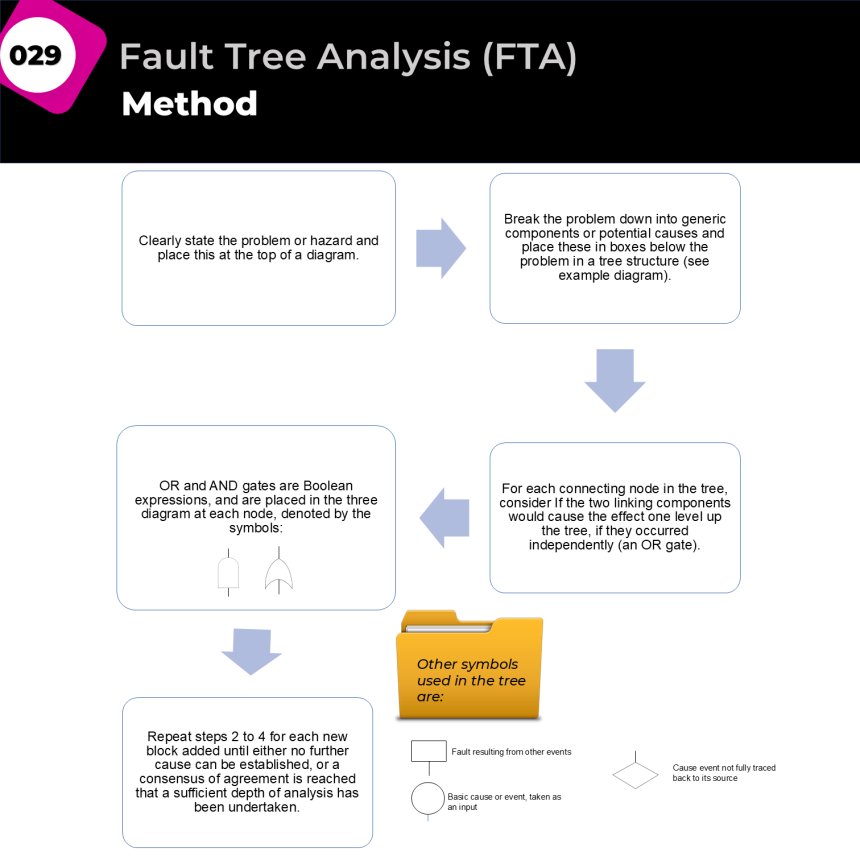
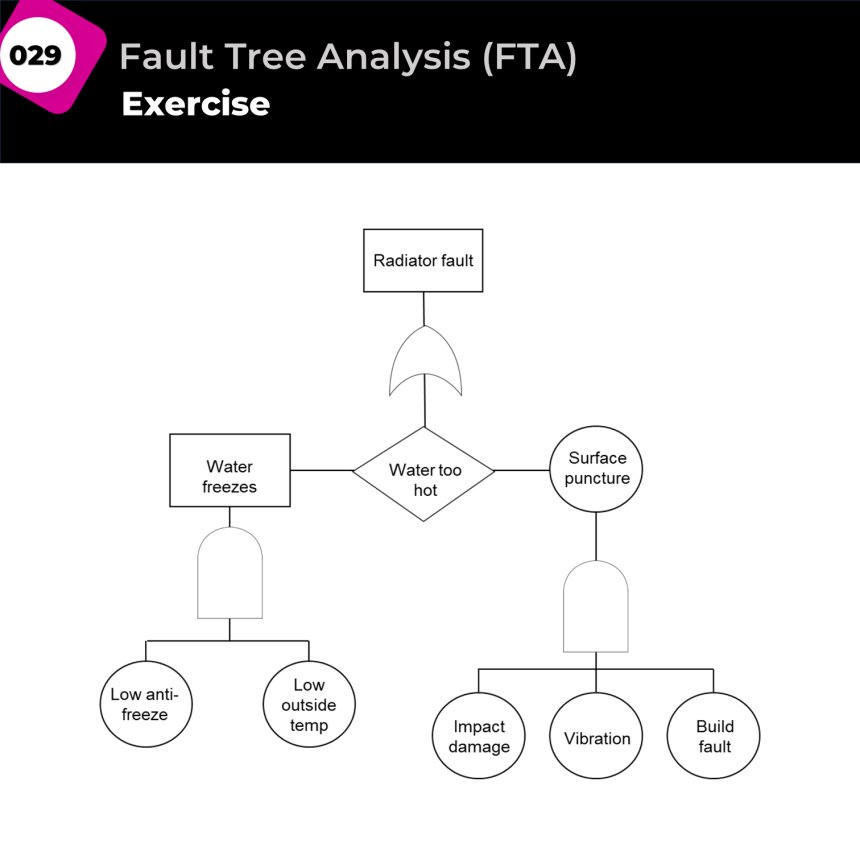
Fault Tree Analysis begins by clearly defining the undesirable event, failure, or hazard that needs to be investigated. This event is placed at the top of the diagram and becomes the focal point of the analysis. The team then identifies the major factors or conditions that could directly contribute to the event and places them beneath the top event in a branching tree structure. Each branch is examined to determine how failures interact and whether a single event can trigger the failure (OR gate) or whether multiple events must occur simultaneously (AND gate).
The process continues by breaking each contributing factor into increasingly detailed causes until the analysis reaches basic events that cannot be meaningfully decomposed further. The result is a logical map that shows the pathways leading to the failure. For complex systems, probabilities may be assigned to each basic event to quantify overall risk and identify the most critical contributors. The completed fault tree helps organisations prioritise controls, mitigation measures, and corrective actions based on the pathways most likely to cause failure.
Example: Suppose a manufacturing plant experiences a critical machine shutdown. The top event is "Machine Failure." The team identifies two primary pathways: Electrical Failure or Mechanical Failure (OR gate). Mechanical Failure may require both Bearing Wear and Lubrication Failure to occur simultaneously (AND gate). By tracing the fault tree downward, the organisation discovers that inadequate lubrication schedules are the most significant contributor, allowing maintenance resources to focus on the highest-risk area.
Best Used When
FTA is most effective when investigating complex failures, hazards, or safety-critical incidents where multiple causes may interact. It is particularly useful when organisations need to understand how different events combine to create a major failure rather than simply identifying isolated causes. The method is widely used in engineering, manufacturing, aviation, energy, healthcare, transportation, and high-risk operational environments.
Typical Applications
- Safety incident investigations.
- Equipment and system failures.
- Reliability engineering studies.
- Process safety assessments.
- Operational risk analysis.
- Critical infrastructure reviews.
- Regulatory and compliance investigations.
- High-risk manufacturing operations.
Key Benefits
- Provides a systematic and logical investigation framework.
- Reveals how multiple failures interact to create major incidents.
- Supports both qualitative and quantitative risk analysis.
- Improves understanding of complex systems.
- Identifies critical failure pathways and vulnerabilities.
- Strengthens preventive and corrective action planning.
- Supports safety, reliability, and operational excellence initiatives.
- Enhances communication of risks through visual mapping.
- Enables prioritisation of risk mitigation efforts.
- Complements FMEA/FMECA and other RCA methodologies.
JSSB Practitioner Note
While Five Whys asks "Why did this happen?" and Fishbone Analysis asks "What factors may have contributed?", Fault Tree Analysis asks:
"What combination of events must occur for this failure or hazard to happen?"
FTA is therefore particularly valuable for high-risk, cross-functional, and safety-critical problems where simple linear cause-and-effect relationships do not adequately explain the failure. It is often used after FMECA to investigate the most critical risks in greater depth.
Files
Share
 Like
0
Like
0
 Dislike
0
Dislike
0
 Love
0
Love
0
 Funny
0
Funny
0
 Angry
0
Angry
0
 Sad
0
Sad
0
 Wow
0
Wow
0