5 Whys
Five Whys is a simple yet powerful Root Cause Analysis (RCA) technique used to uncover the underlying cause of a problem by repeatedly asking the question "Why?". Developed by Sakichi Toyoda and later popularised within the Toyota Production System, the method helps teams move beyond symptoms and surface the fundamental factors driving an issue. By systematically drilling deeper into each answer, organisations can identify the root cause rather than merely treating visible effects. The technique is easy to facilitate, requires minimal resources, and is particularly effective for operational, quality, service, and process-related problems. It is widely used in Lean, Six Sigma, Kaizen, and continuous improvement initiatives to promote learning, problem-solving discipline, and sustainable corrective action.

How to Use
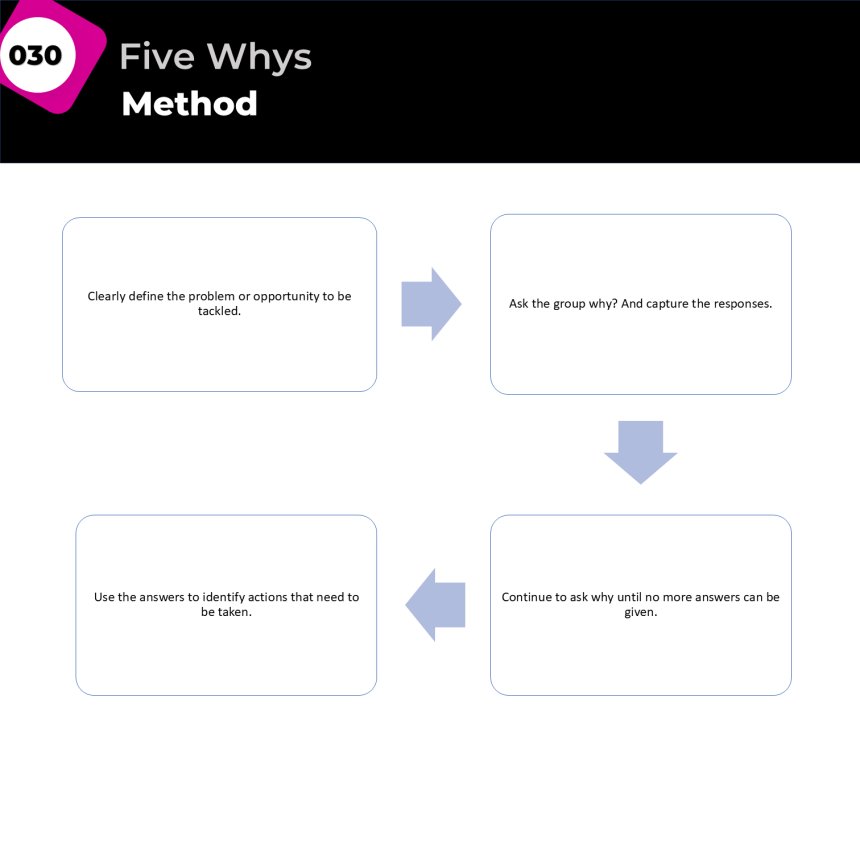
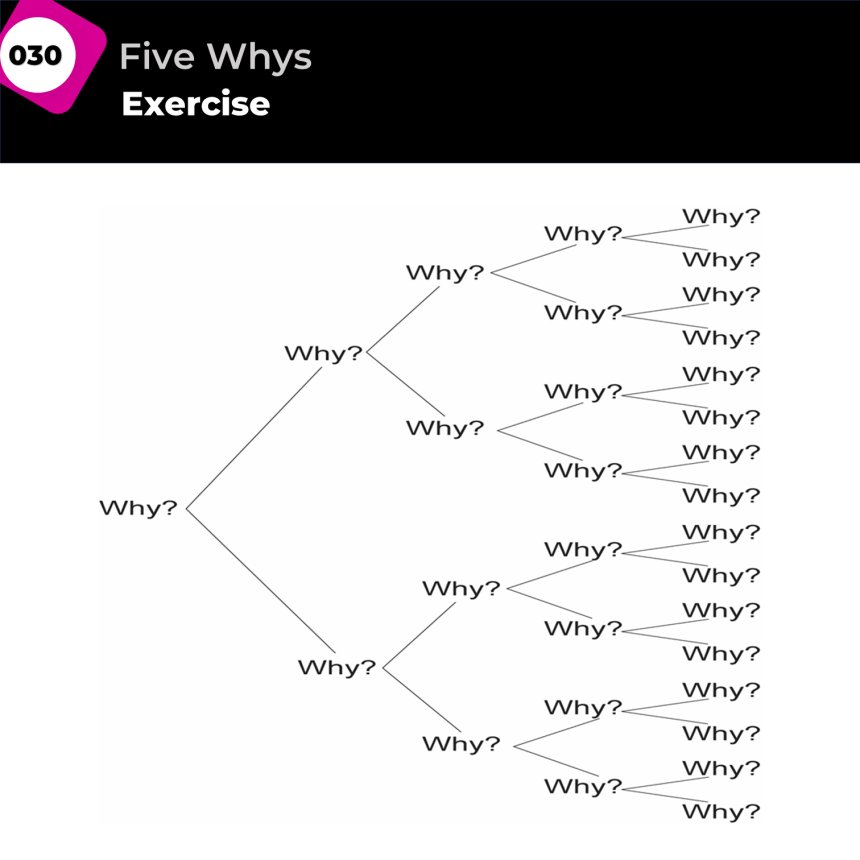
The Five Whys method begins by clearly defining the problem or issue being investigated. The facilitator then asks the question "Why did this happen?" and records the answer. For each answer given, the question "Why?" is asked again to probe deeper into the underlying cause. This process continues until the team reaches a cause that is within the organisation's control to address and no further meaningful "Why" questions can be answered. While the technique is called "Five Whys," the actual number of questions may be fewer or greater depending on the complexity of the issue. The objective is not to reach exactly five levels, but to uncover the true root cause rather than stopping at symptoms.
Typical Steps
- Define the problem clearly.
- Ask "Why did this happen?"
- Record the answer.
- Ask "Why?" again for each answer.
- Continue until the root cause is identified.
- Validate the findings with evidence.
- Develop corrective and preventive actions.
Best Used When
The Five Whys technique is most effective when investigating relatively simple to moderately complex problems where cause-and-effect relationships are reasonably clear. It is particularly useful for operational issues, process failures, quality defects, customer complaints, service disruptions, and recurring workplace problems. The method works best when teams are open, honest, and focused on learning rather than assigning blame. It is often used as an initial RCA tool before applying more sophisticated methods such as Fishbone Analysis, Fault Tree Analysis, or FMEA.
Ideal Applications
- Quality defects and non-conformances.
- Customer service issues.
- Process inefficiencies.
- Operational failures.
- Workplace incidents.
- Continuous improvement projects.
- Lean and Kaizen initiatives.
Key Benefits
The Five Whys technique provides a simple and structured approach for identifying root causes without requiring specialised tools or extensive data analysis. It encourages critical thinking, promotes organisational learning, and helps teams focus on addressing underlying causes rather than repeatedly fixing symptoms. Because it is easy to understand and facilitate, it can be applied quickly across all levels of an organisation, making it one of the most widely used problem-solving tools in Lean, Six Sigma, and Operational Excellence programmes.
Key Benefits
- Simple and easy to apply.
- Requires minimal resources and preparation.
- Identifies root causes rather than symptoms.
- Encourages deeper thinking and investigation.
- Promotes team participation and learning.
- Supports faster problem resolution.
- Reduces recurrence of problems.
- Complements other RCA tools such as Fishbone Analysis and FMEA.
- Strengthens continuous improvement culture.
- Improves decision-making and corrective action effectiveness.
Files
Share
 Like
1
Like
1
 Dislike
0
Dislike
0
 Love
0
Love
0
 Funny
0
Funny
0
 Angry
0
Angry
0
 Sad
0
Sad
0
 Wow
2
Wow
2