Where Are You? Building a Winning Startup Strategy with AI
Explore how companies from start-up use AI across six growth stages, supported by seven strategic elements that connect customer value, organisational capability and sustainable economics. Discover seven elements of a winning AI strategy and how startups can apply them at every growth stage to build capability and deliver lasting value.

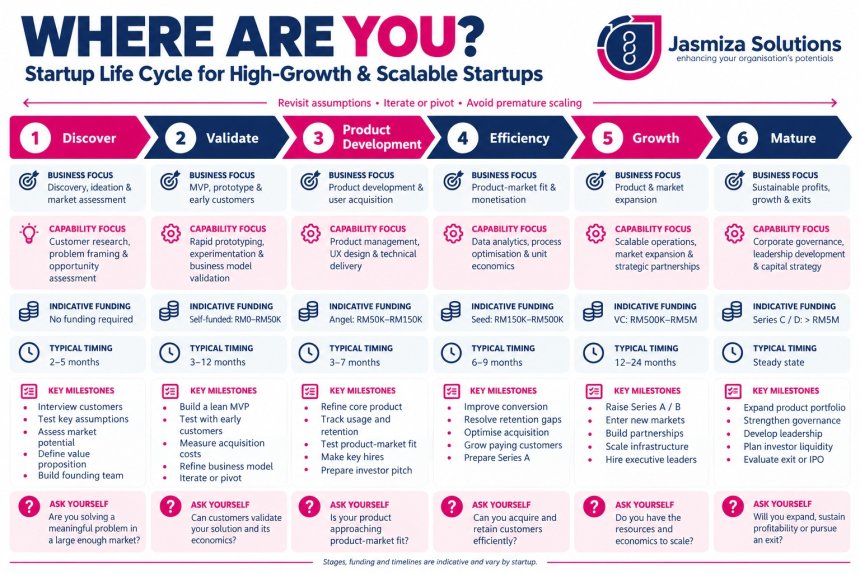
Every startup faces a different challenge as it grows. At the beginning, the priority is finding a meaningful problem. Later, it becomes building the right product, improving profitability, expanding into new markets and sustaining the business.
The six stages in the JSSB Startup Life Cycle—Discover, Validate, Product Development, Efficiency, Growth and Mature—help founders recognise where they are and which capabilities they need next.
AI can support every stage. Its strategic value depends on choosing the right problem, building the capability to use it well and measuring the results.
The key question is: What customer or business outcome can AI help us improve—and how will we prove it?
1. Discover: Use AI to sharpen your understanding
Discovery is about understanding customers, their problems and the market opportunity.
AI can help organise research, summarise interview notes, compare competing offerings and generate ideas for further investigation. These applications can give a small founding team more time to engage with customers.
However, AI-generated customer profiles and market assumptions remain hypotheses. Founders must test them through real conversations and credible evidence.
Capability focus: Customer research, problem framing and opportunity assessment.
AI strategy priority: Use AI to accelerate learning while grounding decisions in customer evidence.
Ask yourself: Which customer problem is frequent, costly or frustrating enough that people will pay to solve it?
2. Validate: Test whether AI creates value customers want
Validation turns an idea into evidence. The aim is to build a minimum viable product, test it with early customers and learn whether the business model works.
Existing AI tools and services can help founders prototype quickly. An AI-enabled service might draft a report, answer questions from a knowledge base or assist with a repetitive task before the startup invests in a full product.
Test the AI-enabled approach against the customer’s current method. Does it deliver a better result? Will customers pay? How much human correction does it require?
Capability focus: Rapid prototyping, experimentation and business model validation.
AI strategy priority: Prove customer value and willingness to pay before making a large technology investment.
Ask yourself: Would customers still choose our solution if another company offered similar AI features?
3. Product Development: Build a reliable customer experience
As the product develops, reliability matters as much as novelty.
An impressive demonstration may perform poorly when customers submit incomplete information, unusual requests or unfamiliar language. Teams need representative test cases, clear quality standards and a way to handle failures.
For example, an AI support assistant should know when to escalate a question to a person. A document-analysis tool should help users check its conclusions against the source material.
Capability focus: Product management, UX design and technical delivery.
AI strategy priority: Build quality evaluation, feedback and human oversight into the product.
Ask yourself: Can customers trust this feature during everyday use, including when it makes a mistake?
4. Efficiency: Improve the economics of the whole workflow
At the efficiency stage, startups need repeatable processes and healthier unit economics.
AI may help with support enquiries, internal knowledge retrieval, sales preparation or document processing. Choose a workflow with a clear bottleneck, establish a baseline and measure what changes.
Consider an AI tool that drafts customer replies. Faster drafting creates limited value if employees spend the saved time correcting errors. Measure the complete process: handling time, accuracy, resolution rate and customer satisfaction.
McKinsey’s research associates workflow redesign with stronger reported financial impact from generative AI. This supports a practical approach: examine how work moves from start to finish when introducing AI. McKinsey’s State of AI research
Capability focus: Data analytics, process optimisation and unit economics.
AI strategy priority: Measure net value after software, integration, review and error-correction costs.
Ask yourself: Are we improving margins and service quality as we become faster?
5. Growth: Scale what has already demonstrated value
Growth introduces more customers, larger teams and new markets. AI can support expansion through localisation, sales assistance, knowledge sharing and demand analysis.
Scaling also exposes weaknesses. A solution that works for one team or language may need substantial adaptation elsewhere. Higher usage can increase costs, and inconsistent data can reduce performance.
Before expanding an AI application, establish clear ownership, access controls, cost monitoring and operating procedures. Train teams to recognise when the system needs human intervention.
Capability focus: Scalable operations, market expansion and strategic partnerships.
AI strategy priority: Expand proven applications with the people, processes and infrastructure needed to sustain them.
Ask yourself: Can this solution maintain quality and acceptable costs at ten times today’s volume?
6. Mature: Turn AI into a lasting organisational capability
Mature businesses need to sustain performance while finding new opportunities.
AI becomes part of wider decisions about governance, leadership, investment and the product portfolio. Leaders should regularly review which applications create value, which need improvement and which should be retired.
NIST’s AI Risk Management Framework provides a useful structure through four functions: Govern, Map, Measure and Manage. Its guidance treats governance as an ongoing responsibility across the AI system’s life cycle. NIST AI RMF Core
Capability focus: Corporate governance, leadership development and capital strategy.
AI strategy priority: Establish accountability and continuous review while developing the organisation’s ability to adapt.
Ask yourself: Are we building skills and knowledge that remain valuable when our technology changes?
Seven elements of a winning AI strategy
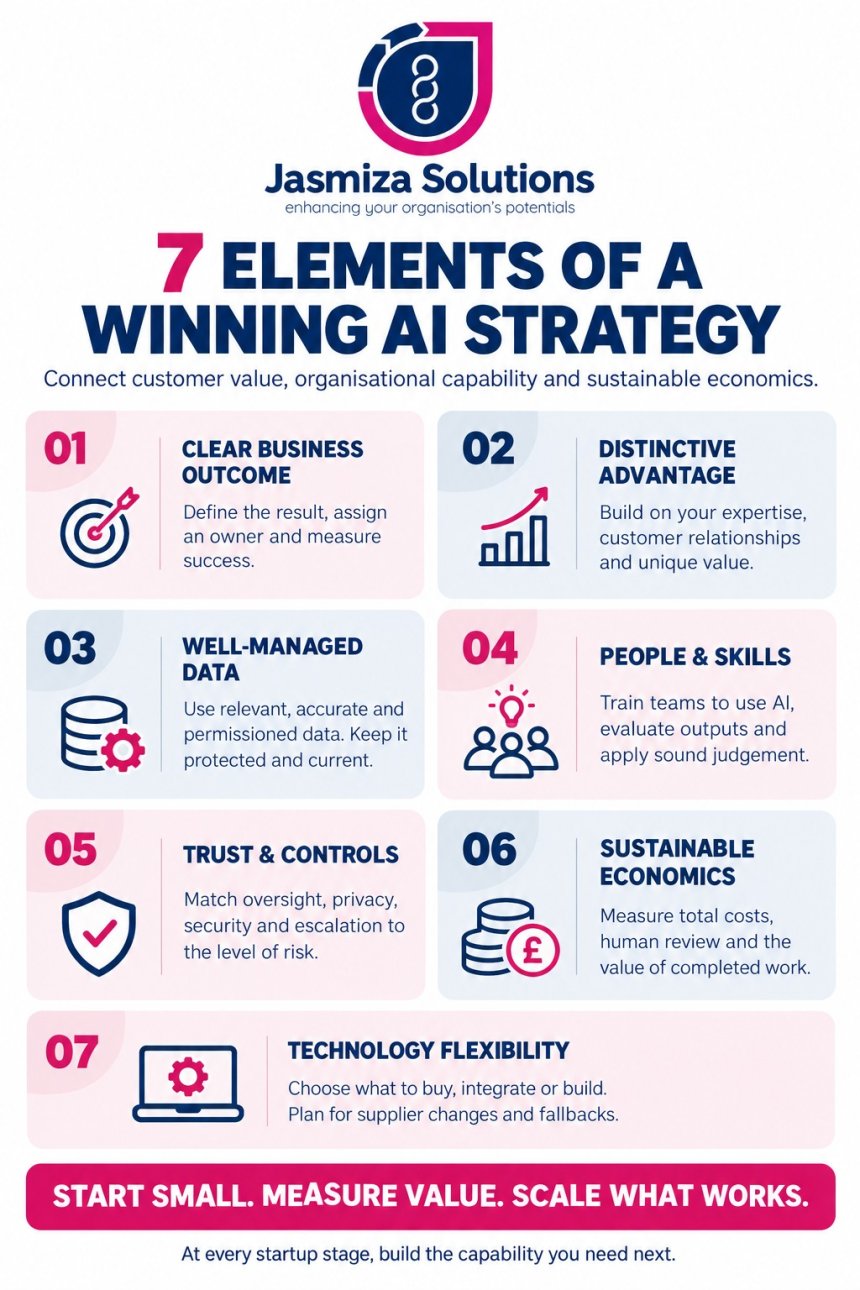
Across all six stages, founders should consider seven connected elements.
1. A clear business outcome
Define the result before choosing the tool: shorter turnaround times, higher conversion, better retention or lower operating costs. Give each initiative an owner and a measurable target.
2. A distinctive advantage
Access to a widely available AI model offers limited differentiation by itself. Consider what makes your solution difficult to reproduce: specialist expertise, trusted customer relationships, useful data you have permission to use, or deep integration into a customer’s workflow.
3. Suitable, well-managed data
Assess whether the data is relevant, accurate, accessible and appropriate for the intended use. Establish how it will be updated, protected and corrected. Poor information can undermine even a capable AI system.
4. People with the right skills
Teams need to understand how to use AI, evaluate its output and apply professional judgement. Training should reflect their actual work. Managers also need to decide how saved time will improve customer service, capacity or innovation.
5. Trust and proportionate controls
Set controls according to the consequences of failure. An internal brainstorming tool and an application influencing consequential customer decisions need different levels of review. Consider privacy, security, inaccurate outputs, misuse and escalation procedures. NIST Generative AI Profile
6. Sustainable economics
Calculate the full cost of delivery, including subscriptions or model usage, integration, monitoring, human review and maintenance. For customer-facing products, track the cost of a successfully completed task alongside revenue and retention.
7. Technology flexibility
Choose how much to buy, integrate or build based on your requirements and resources. Review supplier dependence, data portability and fallback arrangements so the business can respond when pricing, performance or availability changes.
Start with one measurable opportunity
A practical first step is to select one valuable workflow, record its current performance and run a limited pilot. Agree on success criteria before starting, then compare the results—including costs and mistakes—with the baseline.
Expand when the evidence supports it. Improve or stop the initiative when it does not.
The startup life cycle provides direction, but progress is rarely linear. Founders may revisit assumptions, return to validation or strengthen operations before expanding. AI should support those decisions with better information and stronger execution.
A winning AI strategy connects customer value, organisational capability and sustainable economics.
At every stage, ask: What capability do we need next, and where can AI help us build it?
Why not start with AI Capability Readiness Assessment ? Ask your team to assess together , click and share this link : https://www.surveymonkey.com/r/AICapabilityReadiness
Jasmiza Solutions — enhancing your organisation’s potentials
Share
 Like
0
Like
0
 Dislike
0
Dislike
0
 Love
0
Love
0
 Funny
0
Funny
0
 Angry
0
Angry
0
 Sad
0
Sad
0
 Wow
0
Wow
0